


Your teenager can text all day, then freeze the moment they have to speak up in class or sit across from an interviewer.
The secondary school years are the window when communication skills for teens in Singapore are easiest to build, and they shape everything from the O-Level oral to DSA, scholarship, and JC interviews. This guide explains why Secondary 1 to 4 matters most, and how you can help your teen become a clear, confident speaker.
1. Why Communication Skills for Teens in Singapore Matter More Than Ever
2. Why Secondary School Is the Critical Window for Secondary School Communication Skills
3. What Strong Teen Communication Actually Looks Like
4. The Digital Communication Trap Singapore Teens Are Falling Into
5. How Singapore Parents Can Help Their Teen Communicate Better
6. What to Look for in a Communication Programme for Your Teen
7. About SuperMinds: Communication Skills for Teens in Singapore
1. Why Communication Skills for Teens in Singapore Matter More Than Ever
The O-Level English Language oral examination, graded by SEAB, assesses reading aloud and spoken interaction, but the mark it gives is a snapshot, not a measure of lifetime communication ability. What the exam cannot test is whether your child can lead a discussion, persuade an interview panel, or hold a room when the stakes are real.
MOE’s 21st Century Competencies framework explicitly includes communication, collaboration, and civic literacy as outcomes Singapore schools are working toward. But with class sizes of 30–40 students and curriculum pressure in every subject, individual speaking time in a classroom is measured in minutes, not hours.
The practical gap is real. Students who speak clearly, structure their ideas, and hold eye contact are more likely to win CCA leadership positions, earn Direct School Admission (DSA) offers, and perform well in polytechnic and JC interviews. These are not personality traits. They are trainable skills, and the teenage years are exactly when that training sticks.
2. Why Secondary School Is the Critical Window for Secondary School Communication Skills
Between ages 13 and 17, several things happen at once. Identity is forming. Social awareness is at its peak. And the brain is still highly plastic: new communication habits formed now become defaults that carry into adulthood.
A Sec 1 student who learns to structure a two-minute spoken argument will deliver better class presentations in Sec 2, lead group projects more confidently in Sec 3, and walk into their O-Level oral in Sec 4 without the paralysis that catches so many peers off-guard. The compounding effect of building this early is significant.
Compare that with the student who tries to fix their communication habits at 18, just before university or national service (NS). The window is narrower. The stakes are higher. The existing habits are more entrenched. Parents who act during secondary school are working with time on their side.
The secondary school years also come loaded with high-stakes speaking moments your child needs to be ready for: class presentations, CCA leadership elections, school debates, group discussions in oral examinations, scholarship interviews, DSA interviews, and polytechnic or JC entry interviews. Each one is a real opportunity, and missing it has real consequences.
3. What Strong Teen Communication Actually Looks Like
Strong communication in a teenager is not the same as being loud, outgoing, or naturally confident. It is a set of specific, observable behaviours:
These skills matter in the O-Level oral, but they matter far more in every career conversation, interview, and leadership moment your child will face after school. Investing in them during secondary school means your child is not playing catch-up at 22.
4. The Digital Communication Trap Singapore Teens Are Falling Into
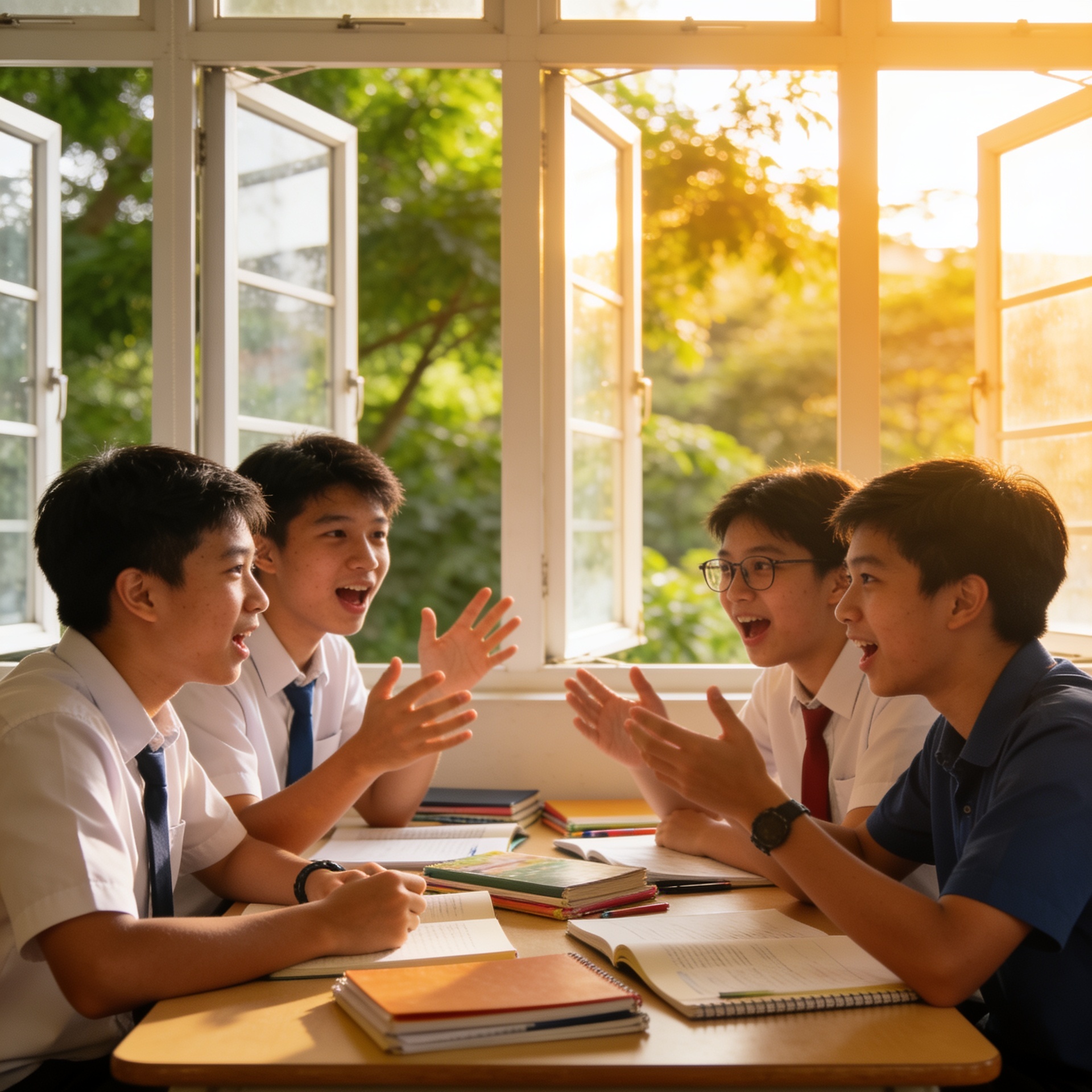
Post-COVID, Singapore secondary schools normalised Zoom presentations and Google Slides-heavy lessons. Many teens today are more comfortable presenting to a screen than to a live audience. This is not a character flaw: it is a product of the environment they grew up in.
But it creates a specific gap. Group project work, a staple from Sec 1 onwards, increasingly involves typed collaboration over Telegram or Google Docs. Speaking in full sentences, listening without a prepared script, and disagreeing politely out loud are becoming rare experiences for many teens.
The result: when they land in a polytechnic interview, a CCA selection panel, or an NS officer assessment, they are being evaluated on face-to-face communication they have had very little practice with. Social media fluency does not transfer to spoken confidence. The two use completely different muscles.
The fix is practice: specifically, structured practice with real-time feedback in a safe environment. Typing corrections at home will not build this. Live speaking practice, with a trained observer giving immediate feedback, is what moves the needle.
5. How Singapore Parents Can Help Their Teen Communicate Better
You do not need a background in communication to help your child. You need consistent, low-pressure opportunities and a few concrete techniques:
Ask open questions at dinner. Not “How was school?” (answer: “Fine.”) but “What’s one thing that surprised you today?” or “If you could change one thing about how your group project is going, what would it be?” Open questions require structured responses. They are low-stakes oral practice.
Watch and debrief one TED Talk per fortnight together. Pause at moments of strong delivery: clear structure, a pause for effect, a direct look at the camera. Ask your teen: “What made that work?” This builds analytical awareness, which translates into self-correction when they speak.
Resist the urge to finish their sentences. When your teen is struggling to articulate something, the natural parental instinct is to help. Resist it. The productive discomfort of searching for the right word in real time is exactly the skill they need to develop.
Encourage CCA leadership roles, not just academic enrichment. Leading a CCA committee, organising an event, or representing the school at an external competition all develop communication under real pressure. These also feed directly into DSA applications, which reward demonstrated leadership and communication ability.
Invest in structured programme time during school holidays. The June holidays and December holidays are the most practical windows for focused communication skills development. A structured programme gives teens feedback they cannot get from family, from a trained professional who sees them objectively.
6. What to Look for in a Communication Programme for Your Teen
Not all enrichment programmes build the same thing. Here is what matters when you are evaluating options for your Sec 1 to Sec 4 child:
Small class sizes. Speaking time is finite. In a class of 20, your child speaks for a fraction of the session. Look for programmes with a maximum of 8–10 students so every teen gets multiple speaking rounds with real feedback per session.
Real-world content, not performance. Some programmes focus on theatrical delivery: projecting emotions, adopting characters, performing speeches. These may build confidence in one narrow context. What your teen needs for DSA interviews, school presentations, and JC entry is real-world communication: structured thinking, spontaneous responses, and conversational clarity. Ask whether the programme prepares for performance or for real situations.
Immediate, specific feedback. Feedback like “good job” or “speak louder” does not develop skill. Look for coaches who tell teens exactly what to change and why, and who give them a chance to try again in the same session.
Video recording of sessions. Watching yourself back is one of the fastest ways to improve. Many teens have no idea what their facial expression looks like when they are nervous, or how fast they speak under pressure. Video closes that gap in minutes.
7. About SuperMinds: Communication Skills for Teens in Singapore
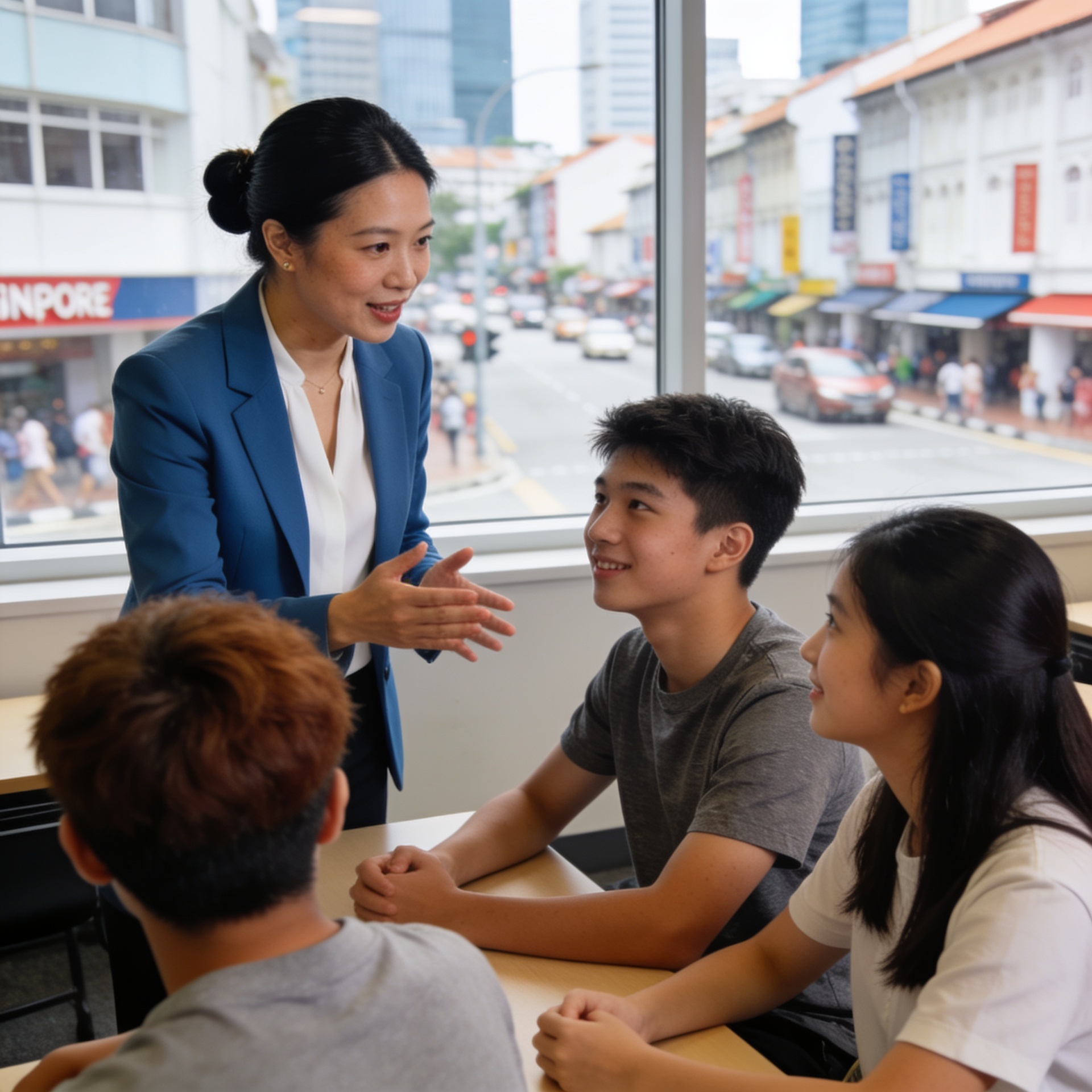
SuperMinds is Singapore’s specialist communication trainer for children and teenagers, built on the 3 Cs: Character, Communication, and Confidence. Founded by Iwan Yang, Founder & Programme Director, who has personally trained more than 3000+ adults, teens and children across Singapore. Iwan is Singapore’s most reviewed communication trainer, with 500+ five-star reviews across Google, Facebook, and LinkedIn.
The SuperMinds teens programme, designed specifically for students aged 13–17 (Sec 1–4), develops real-world communication skills, not performance. Students work on structured argumentation, spontaneous speaking, active listening, and composure under pressure. Sessions are conducted by Iwan Yang and trained SuperMinds coaches working under his method and supervision, in classes of no more than 8 students. Every student speaks multiple times per session and receives immediate, specific feedback from a trained coach.
SuperMinds teaches real-world communication, not speech and drama, not elocution, not performance. If your child needs to hold their own in a DSA interview, school oral examination, CCA leadership role, or eventually a polytechnic or JC application, this is the programme built for that. Learn more about the SuperMinds teens programme or explore our DSA interview preparation for one-on-one coaching with Iwan Yang directly.
A trial class costs S$59.50 and includes a video recording of your child speaking and a written coach evaluation. It is the clearest way to see what structured communication training looks like in practice. Book a trial class here.
8. Frequently Asked Questions
My teenager is naturally shy. Will a communication programme help, or is it just for confident kids?
Structured communication training is more valuable for quieter teens, not less. Shy teenagers often have clear thinking but lack the specific techniques to organise and deliver it under pressure. Small class sizes (SuperMinds caps at 8 students) mean every student speaks: there is no hiding at the back. Most parents report visible change in composure and clarity within the first few sessions.
How early in secondary school should we start?
Sec 1 or Sec 2 is the ideal time. Starting early means your child develops habits before the pressure of O-Level examinations in Sec 4. It also means they can take on CCA leadership roles from a position of genuine confidence, and they will have years of compounding practice behind them before polytechnic and JC interviews.
Will communication training actually help with the O-Level English oral exam?
Yes, directly. The O-Level oral component includes reading aloud and a spoken interaction segment. Students who have practised structured thinking, vocal control, and composure under pressure perform significantly better. But the value extends well beyond the exam: a student who can hold a conversation fluently with an examiner is also the student who impresses a DSA panel or a polytechnic interviewer.
My child is in Sec 3. Is it too late to start?
Not at all. Sec 3 is actually one of the best times to start: there is still a full year before the O-Level oral, time to use the December holidays for intensive practice, and the DSA Sec window opens in Sec 3. Students who start in Sec 3 routinely make rapid progress because they are cognitively ready to absorb and apply feedback quickly.
How is SuperMinds different from a speech and drama class?
SuperMinds is not speech and drama. Speech and drama focuses on theatrical performance: character expression, scripts, and stage presence. SuperMinds teaches real-world communication: how to structure and deliver ideas clearly and spontaneously in interviews, presentations, and discussions. The two programmes serve different goals. If your child wants to perform on a stage, speech and drama is appropriate. If they need to communicate clearly in a DSA interview, school presentation, or future job interview, SuperMinds is the right choice.
Where are your classes held and what are the fees?
SuperMinds is located at 250 Tanjong Pagar Road, St Andrew’s Centre, #04-01, Singapore 088541, a short walk from Tanjong Pagar MRT. A trial class is S$59.50 and includes a video recording of your child speaking and a written evaluation from a SuperMinds coach. WhatsApp us at +65 6602 8262 for class schedules and availability.
The years your child spends in secondary school are the best opportunity they will have to build communication as a genuine strength. Book a trial class at S$59.50 and see the difference structured communication training makes.