
Most children know how to talk. Very few have been taught how to have a conversation.
The difference matters more than parents realise. Talking is producing words. Conversation is a structured exchange: asking and answering, listening and responding, adapting what you say based on what the other person just said. These are learnable skills, but they don't develop automatically. They develop through deliberate exposure and practice.
This guide is for parents of children aged 9 to 17 in Singapore who want to understand what conversational skills actually involve, and what they can do to help their child build them.
1. What Conversational Skills Actually Are (and Why They're Hard to Teach)
Conversational skills are the underlying abilities that make meaningful exchange possible. They include: knowing when to speak and when to listen, asking questions that genuinely engage the other person, staying on topic while adding something new, reading the listener's signals to know whether they're engaged or lost, and navigating disagreement without shutting down or becoming defensive.
These skills are hard to teach at home for two reasons. First, they require real interaction to develop. You can explain how to listen actively, but the skill only builds through the repeated experience of actually doing it. Second, most parents model these skills without being able to articulate them. When a parent asks a follow-up question naturally, they aren't consciously thinking "I'm applying active listening now." They just do it. Teaching it to a child requires making the invisible visible.
The good news is that once parents understand what the specific components are, they can create targeted practice conditions at home, and see real improvement within weeks.
2. The Core Components of Strong Conversation
Breaking conversation down into its components makes it teachable. These are the five most important building blocks for children aged 9 to 17.
Active listening. This is not silence while waiting to speak. It is engaged attention: tracking what the other person says, noticing when something needs clarification, and responding to the actual content rather than a parallel thought. For children, the most visible sign of active listening is the quality of their follow-up: does their response connect to what was just said, or does it redirect to something unrelated? Teach active listening by asking your child to summarise what they just heard before responding.
Turn-taking and timing. Knowing when to speak is as important as knowing what to say. Children who talk over others, fill every silence, or wait so long that they lose the thread are all struggling with turn-taking, for different reasons. Comfortable silence, reading facial cues, and tracking the natural rhythm of a conversation are all aspects of this skill that can be practised in low-stakes family settings before they're needed in high-stakes school or social contexts.
Asking meaningful questions. Most children ask questions that require a yes or no answer. Teach them open questions, such as "What did you think about that?" rather than "Did you like it?" Open questions extend conversations, signal genuine interest, and build rapport. They also require the questioner to actually listen to the answer, which reinforces active listening simultaneously.
Staying on topic while contributing. A strong conversationalist can build on what was just said rather than steering every exchange back to their own experience. For children, this means noticing when they redirect to themselves too quickly, with "That reminds me of when I...", and practising the habit of extending the other person's thread before introducing their own.
Adapting to the listener. Explaining something to a classmate and explaining the same thing to a grandparent require different vocabulary, different pace, and different assumptions about what needs to be said. Children who can make this adaptation naturally are demonstrating a sophisticated communication skill that most adults haven't consciously developed. Start practising it early, by asking your child to explain something they know well to different imaginary audiences.
3. How Conversational Skills Develop at Different Ages
Understanding what to expect at each stage helps parents focus their efforts and avoid either over-expecting or under-expecting from their child.
Primary 1 to 2 (ages 7 to 8). At this stage, children are building the foundations: taking turns in simple exchanges, asking basic questions, and beginning to track a simple conversation thread. Most children this age still struggle to stay on topic for more than a few exchanges. Focus on the habit of listening before responding. Even one breath of deliberate pause before speaking trains attention over time.
Primary 3 to 4 (ages 9 to 10). By this stage, children can sustain longer conversations and handle more complex topics. The challenge is depth: many P3 to P4 children can speak at length but rarely ask questions that move a conversation forward. This is the most important age to introduce open questions as a deliberate habit. The impact on school participation, friendship quality, and PSLE Oral preparation is significant.
Primary 5 to 6 (ages 11 to 12). By P5 to P6, children should be developing the ability to navigate conversations that involve disagreement or different perspectives. This is when the skill of respectful disagreement, acknowledging the other person's point before introducing a different view, becomes both teachable and urgently needed. It is directly tested in PSLE Oral's Stimulus-Based Conversation, where the examiner challenges the student's initial answer.
Secondary 1 to 4 (ages 13 to 16). Teens face more sophisticated conversational demands: group discussion, peer collaboration, adult interviews (DSA), and social navigation across different groups. The skills built in primary school are the platform everything else rests on. Teens who have consistently practised conversational skills handle group dynamics, leadership situations, and high-stakes interviews with noticeably more ease than those encountering these demands for the first time.
4. How to Build Conversational Skills at Home
Home is where most conversational skills are built, through the quality of daily family interaction, not through dedicated practice sessions. The most effective changes parents can make are structural: small adjustments to everyday routines that increase the density of genuine conversation practice.
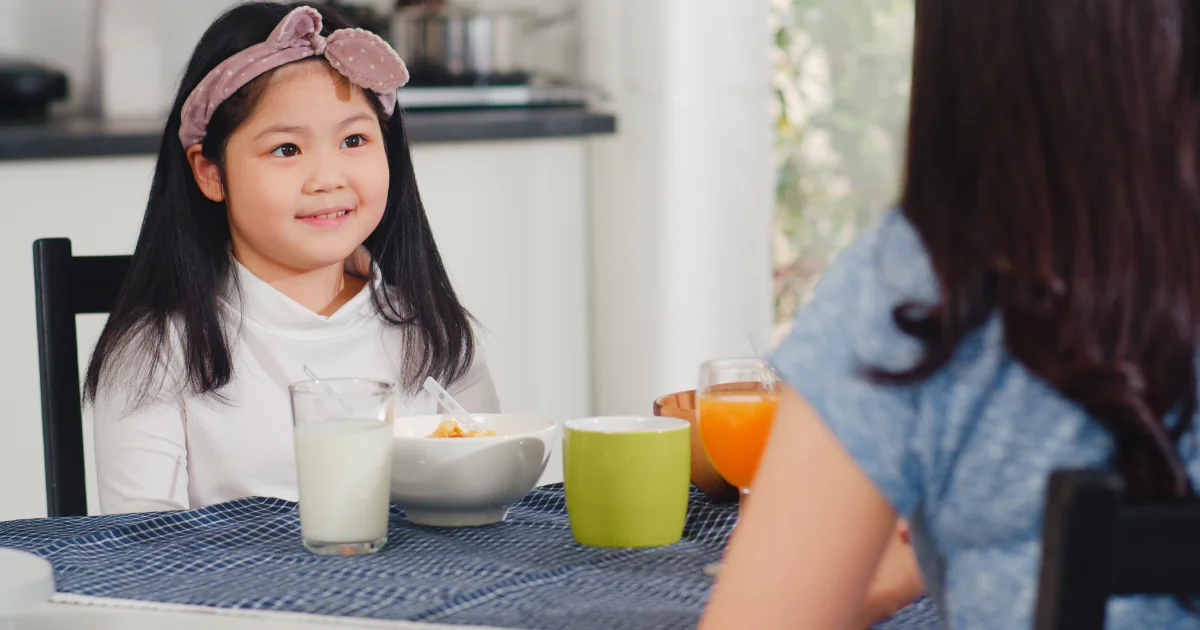
The dinner table question rule. Agree as a family that dinner conversations will include at least one open question from each person. Not "How was school?" (closed, predictable) but "What happened today that you didn't expect?" or "What's something you understood better by the end of the day than you did at the start?" The question type matters: it trains your child to think of open questions as the normal form of conversational engagement.
The follow-up rule. Before your child is allowed to introduce a new topic, they must ask at least one follow-up question about the topic just discussed. This prevents the pattern of each family member reporting their day in sequence, which is not conversation, it's parallel monologue. The follow-up rule forces listening and builds the habit of genuine engagement with what the other person has said.
The explain-to-someone-else exercise. Ask your child to explain something they know well, such as a game, a concept from school, or a book they're reading, as if they're talking to someone who has never heard of it. Then ask them to explain the same thing to a 6-year-old. The exercise reveals how much of their existing vocabulary and explanation style assumes prior knowledge, and it builds the adaptability that strong conversationalists have naturally.
The disagreement script. Choose a topic your child will instinctively disagree with and state your position clearly. Ask them to respond without either immediately agreeing or becoming defensive. Teach them a simple three-part structure: acknowledge the point you've just heard, state their own view, give a reason. This maps directly onto what they'll need in PSLE Oral, DSA interviews, and group project discussions. Practising it at home in low stakes makes it available in high stakes.
5. How This Connects to School: PSLE Oral, Presentations, and DSA
Conversational skills are not a soft add-on to academic preparation in Singapore's education system. They are directly assessed, from P3 through to secondary school and beyond.
PSLE Oral: Stimulus-Based Conversation. This component tests exactly the skills described in this guide: responding to a prompt, answering a follow-up question, handling a challenge to the initial answer, and maintaining composure throughout. The examiner is specifically trained to probe the student's reasoning and to push back on their initial position. A child who has practised turn-taking, open questions, and respectful disagreement in daily conversation will find this examiner dynamic familiar, not threatening.
School presentations from P3 onwards. The question-and-answer component that follows most school presentations is a conversational challenge, not a speaking challenge. Teachers and classmates ask unpredictable questions. Children who can respond naturally, ask for clarification when needed, and think aloud without panic are demonstrating conversational fluency that presentation training alone cannot build.
DSA interviews. From P5 and P6, families preparing for Direct School Admission need children who can hold a genuine conversation with a panel of senior educators, not just deliver a prepared response to expected questions. The ability to build rapport, listen carefully, adapt on the fly, and engage with the panel's direction rather than sticking to a script is the difference between a promising candidate and a prepared-sounding one. Secondary schools interviewing DSA candidates are specifically looking for the former.
The investment in conversational skills during primary school pays compound returns at every subsequent stage. For a look at how structured training develops these skills alongside public speaking, see our guide to public speaking classes for children in Singapore.
6. About SuperMinds
SuperMinds was built on the understanding that the skills Singapore children most need, clear expression, genuine listening, composure in conversation, are not developed by any single component of the school curriculum. They require deliberate practice in conditions that mirror real-world communication: small groups, real exchange, structured feedback, and repeated challenge over time.
Iwan Yang, Founder & Programme Director and Singapore's most reviewed communication trainer, spent years working with adult professionals across Asia before adapting his methodology for primary and secondary school students. The programme runs in groups of up to 8 students, small enough that every child speaks in every session, receives individual feedback, and develops the specific skills they're actually missing rather than practising what they already do well.
Trial classes are available at S$59.50 and include a video recording of your child speaking plus a written evaluation from a trained SuperMinds coach.
We run classes for children (ages 9 to 12) and classes for teens (ages 13 to 17) at 250 Tanjong Pagar Road, St Andrew's Centre, #04-01, Singapore 088541, near Tanjong Pagar MRT. WhatsApp us at +65 6602 8262.
7. Frequently Asked Questions
What are conversational skills for children?
Conversational skills are the underlying abilities that make meaningful exchange possible: active listening, turn-taking, asking open questions, staying on topic while contributing something new, and adapting your communication style to different listeners. They differ from general speaking skills in that they are inherently two-way: they require responsiveness and flexibility, not just the ability to produce words. In Singapore's education system, they are directly tested through PSLE Oral's Stimulus-Based Conversation, DSA interviews, and everyday classroom participation.
How do I know if my child has weak conversational skills?
Look for these patterns: they dominate conversations without asking questions, or they stay silent and let others lead entirely. They redirect every topic to their own experience before engaging with the other person's. They struggle to respond when asked a follow-up question they didn't prepare for. They give very short answers to open questions (one or two words) even when they clearly have more to say. They avoid conversations with unfamiliar adults. Any of these patterns suggests a skill gap that can be addressed with deliberate practice.
What's the difference between conversational skills and public speaking?
Public speaking is primarily one-way: a prepared message delivered to an audience. Conversational skills are inherently two-way: they require listening and responding in real time, adapting to unexpected questions, and building rapport through genuine exchange. Both are valuable, and they reinforce each other. A child who is comfortable in conversation tends to be more natural in their public speaking, and a child who has practised public speaking tends to be more organised in conversation. They are different skill sets that develop somewhat independently, and both deserve attention.
At what age should children start developing conversational skills?
Conversational foundations begin developing from the earliest years through the quality of parent-child interaction at home. From P3 (age 9), children have the cognitive development to engage with the more structured aspects: open questions, turn-taking rules, respectful disagreement. P3 to P6 is the highest-leverage window for deliberate development because the skills built in these years are the foundation for everything that follows: PSLE Oral, DSA interviews, secondary school leadership, and workplace communication.
How long does it take to improve a child's conversational skills?
Visible change in specific habits, such as asking more open questions and making stronger follow-ups, typically appears within three to four weeks of consistent daily practice. Deeper changes in conversational flexibility and composure under pressure take longer: two to three months of regular practice in varied conditions. The most important factor is consistency rather than intensity. Brief daily interactions that apply the skills deliberately produce faster and more durable results than occasional long practice sessions.
Can an introverted child develop strong conversational skills?
Yes, and introverted children often have an advantage in conversation once they develop the structural habits, because they tend to think carefully before speaking and listen more naturally than extroverted children. Introversion is a preference for lower stimulation and more internal processing; it is not the same as being unable to converse. The barrier for introverted children is usually not capability. It is the discomfort of initiating and sustaining exchange in unfamiliar settings. Small group practice environments, like SuperMinds' sessions of up to 8 students, are specifically effective for introverted children because the group size is manageable and every child participates in every exchange.