

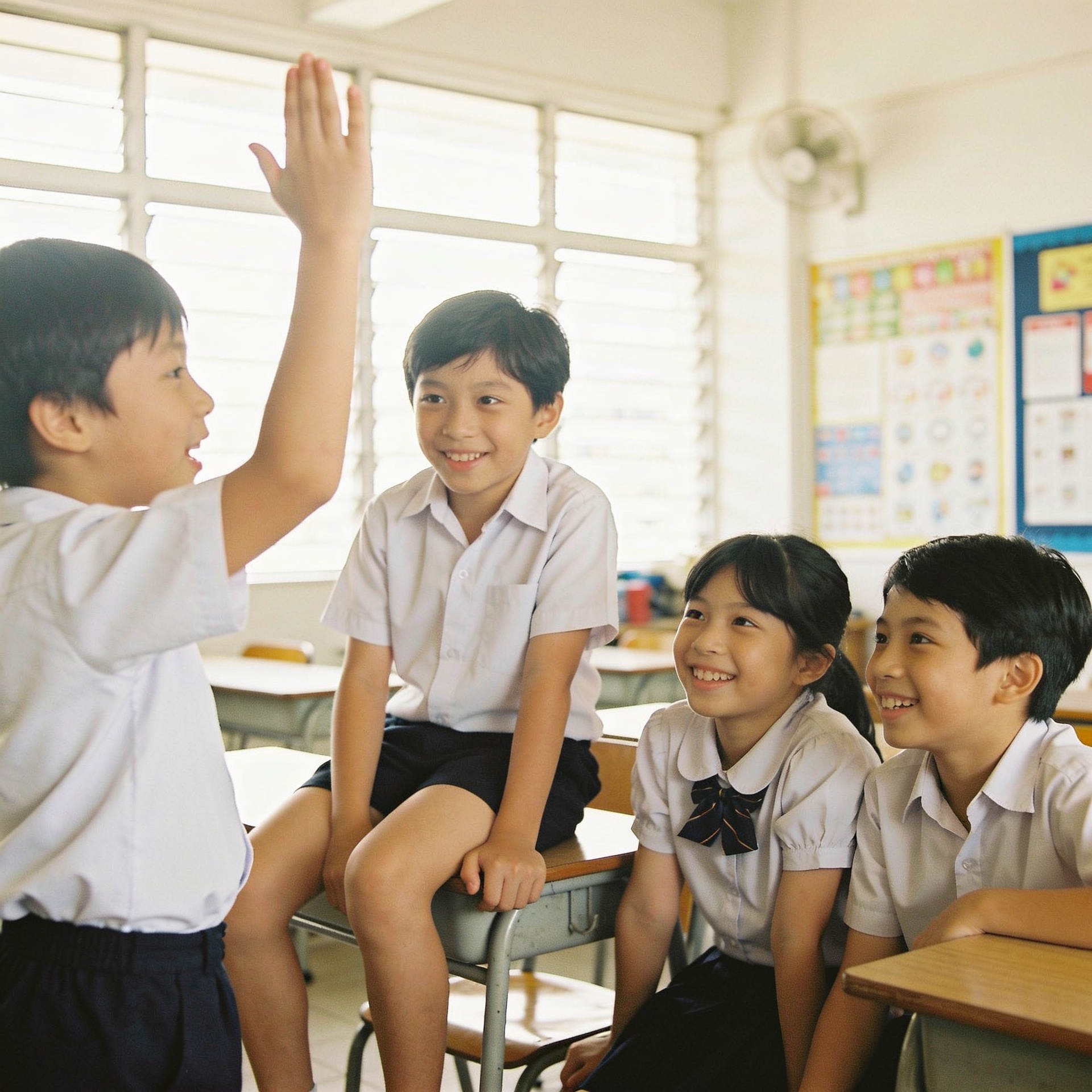
Your child knows the answer. You can see it on their face. But when the teacher asks, the hand stays down and their eyes drop to the desk.
If your child goes quiet in the moments that matter, you are not alone, and it is not a fixed trait. Knowing how to build confidence in a shy child takes the right kind of practice, not pressure. This guide covers what actually works, at home, at school, and through structured practice beyond the classroom.
1. Understand the Difference Between Shyness and Introversion
2. Start Small: Build Confidence Through Low-Stakes Conversation
3. Help Your Child Prepare for Speaking Moments at School
4. How to Build Confidence in a Shy Child: The Role of Structured Practice Outside School
5. Reframe How You Talk About Shyness at Home
1. Understand the Difference Between Shyness and Introversion
Before trying to change your child's behaviour, it helps to understand what is actually happening. Shyness is a fear response: the worry of being judged or getting something wrong in front of others. Introversion is an energy preference: introverts recharge alone and process experiences internally. Many children are a mix of both, but they are not the same thing.
Pushing a shy child to “just speak up” without addressing the underlying fear rarely works. It can even backfire, making them associate speaking with pressure and embarrassment. A more effective approach starts with creating enough safety and repetition that speaking up begins to feel normal rather than threatening.
What both shy and introverted children share is that they tend to think before they speak. This is actually a communication strength, not a weakness. Your goal is not to turn your child into a loud extrovert; it is to give them the tools to express their thinking clearly when it matters.
2. Start Small: Build Confidence Through Low-Stakes Conversation
One of the most effective techniques for building confidence in a shy child is to reduce the stakes of everyday speaking. At home, make it a habit to ask your child open-ended questions that require more than a yes or no answer: “What was the most interesting part of your day?” or “If you could change one thing about recess, what would it be?” Listen fully without correcting or rushing them.
Expand this gradually into semi-public settings. Order their own food at a hawker centre. Ask the librarian at your local NLB branch for a book recommendation. Request a size exchange at a shop. These micro-interactions build the neural pathways of “I spoke to a stranger, it went fine, I am okay,” which is exactly the evidence base confidence requires.
The NLB runs regular programmes and events for children and teens at public libraries across Singapore. Encouraging your child to attend and to interact with facilitators provides structured, low-pressure practice in a non-school environment.
3. Help Your Child Prepare for Speaking Moments at School
The Singapore school environment puts real communication demands on children from Primary 3 onwards. P3 and P4 students face in-class presentations, show-and-tell activities, and group work. By P5 and P6, they are preparing for the PSLE Oral, which now includes the Stimulus-Based Conversation (SBC) component, where students must respond spontaneously to a visual prompt and hold a natural conversation with an examiner.
For a shy child, the SBC is particularly challenging because it cannot be scripted. Preparation has to be experiential: practise conversations at home using photos from books or newspapers as prompts. Ask your child for their opinion, follow up with “why?” and “what do you think would happen if...?” The goal is to make spontaneous talking feel less frightening through repetition, not memorisation.
If your child's school has a Debate CCA, Speech CCA, or similar co-curricular activity, encourage them to try it. CCA participation is tracked in the PSLE holistic assessment, and communication-focused CCAs build exactly the skills shy children need most. The structured environment and regular meetings make it easier to participate than a one-off speaking task.
4. How to Build Confidence in a Shy Child: The Role of Structured Practice Outside School
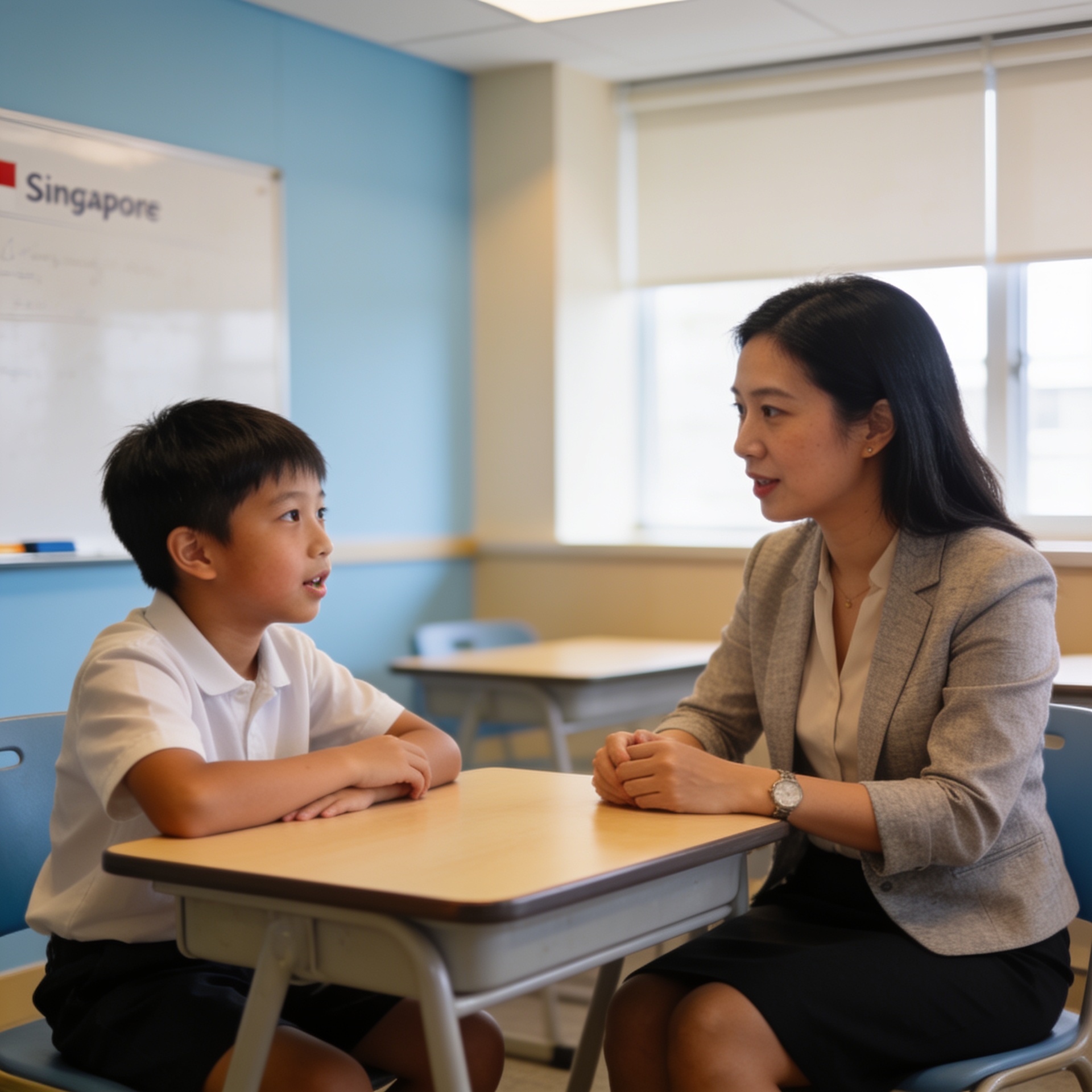
Home practice and school CCAs are valuable, but they have limits. At home, parents are not trained to give the kind of specific, structured feedback that builds skill. At school, the class size is too large and the focus is on curriculum, not communication development.
This is why many Singapore parents turn to enrichment classes specifically designed around communication skills. The key is choosing a programme that focuses on real-world communication, not performance. Speech and drama classes teach children to perform scripts and project emotions on stage. That is a different skill set from the one your shy child actually needs: the ability to organise their thoughts under pressure, respond to questions, and express their views clearly in everyday situations.
Look for small class sizes of eight students or fewer, so your child gets genuine speaking time in every session, not just one turn every 30 minutes. And look for programmes that provide recorded feedback, so your child can see their own progress over time. That visible evidence of growth is one of the most powerful confidence-builders there is.
The June holidays and December school holidays are often the best entry point. Your child has the headspace to try something new without the pressure of ongoing schoolwork, and a school holiday programme lets them build initial confidence before carrying it into Term 3 or the new school year.
5. Reframe How You Talk About Shyness at Home
The language parents use around shyness shapes how children see themselves. Saying “he is just shy” in front of your child, even affectionately, can lock in a self-concept that is hard to shift. Children hear “I am a shy person” and treat it as a fixed truth rather than a current state.
Try reframing towards behaviour rather than identity. Instead of “she is shy,” try “she takes a little time to warm up, and once she does, she has a lot to say.” Instead of “don't be shy,” try “I know this feels new. What would make it easier?” These shifts are small but they preserve your child's sense of agency. They separate who your child is from how they are currently behaving.
Also notice and name small wins out loud. Not with excessive praise, just a quiet, specific acknowledgement. “You asked the teacher that question yourself today. That took courage.” Children who are noticed for specific acts of bravery start to build a new self-narrative: “I am someone who can speak up.”
6. Use Singapore's Cultural Context as an Advantage
Singapore's high-pressure academic environment, with PSLE, DSA interviews, and P6 streaming anxiety, creates real communication demands on children. But this same context also creates motivation. Many parents and children understand that strong communication skills are not just a “soft skill,” as they directly affect academic results, DSA outcomes, and future opportunities.
The DSA (Direct School Admission) process, for instance, includes interviews at secondary schools. P5 and P6 students who apply for DSA places must be able to articulate why they want to attend a particular school, what they contribute, and how they think, clearly, directly, and under pressure. A shy child who has not built these skills by P5 faces a genuine disadvantage in the DSA process.
Esplanade's family and children's arts events at the Esplanade also offer a culturally rich setting where children can engage with storytelling, performance, and creative expression in relaxed, public spaces, providing another low-pressure way to expose shy children to voices and ideas beyond their own.
Frame communication skill-building for your child as something that helps them in all these areas, not as fixing a flaw, but as building a tool they will use for the rest of their life.
7. About SuperMinds
SuperMinds is Singapore's specialist programme for children's and teens' communication skills, built on the principles of Character, Communication, and Confidence. Founded by Iwan Yang, Founder & Programme Director, who has personally trained more than 3000+ adults, teens and children across. Iwan is Singapore's most reviewed communication trainer, with 500+ five-star reviews across Google, Facebook, and LinkedIn.
Sessions are delivered by Iwan Yang and trained SuperMinds coaches working under his method and supervision. SuperMinds teaches real-world communication, not performance. There are no scripts, no costumes, and no stage. The children's programme is designed for P3–P6 students aged 9–12, with a maximum class size of 8 students so every child speaks in every session. For P5 and P6 students preparing for DSA interviews, SuperMinds also offers one-on-one DSA preparation coaching conducted directly by Iwan Yang.
The trial class is S$59.50 and includes a video recording of your child speaking plus a written coach evaluation, giving you concrete evidence of where they are starting and where they can go. SuperMinds is located at 250 Tanjong Pagar Road, St Andrew's Centre, #04-01, Singapore 088541, a short walk from Tanjong Pagar MRT. To find out more or book a slot, WhatsApp the team at +65 6602 8262 or book a trial class here.

8. Frequently Asked Questions
My child is very shy at 10 years old. Is it too late to change this?
Not at all. The primary school years, from P3 to P6, are actually an ideal time to build communication confidence. Children at this age are developing their sense of identity and are highly responsive to structured, positive speaking experiences. With consistent practice in the right environment, most children show noticeable change within a few months.
How is an introverted child different from a shy child, and does the approach change?
Shy children are held back by fear of judgement. Introverted children simply prefer quieter environments and need more processing time. Many children are both. The practical approach overlaps significantly: both benefit from low-stakes practice, small group settings, and consistent repetition. The key difference is that a shy child also needs reassurance and emotional safety alongside skill-building, while an introverted child mainly needs structure and time to think before speaking.
Will my child's PSLE Oral results improve if they build communication skills?
Yes, in a direct way. The PSLE Oral's Stimulus-Based Conversation (SBC) component rewards children who can hold a natural, flowing conversation and share their views spontaneously. This is not a skill that comes from drilling model answers; it comes from regular, varied practice having real conversations. Children who build genuine communication confidence consistently outperform those who only memorise PSLE Oral scripts.
My child refuses to speak in class even though they are fine at home. Why?
This is extremely common. The classroom is a high-stakes social environment where children fear being wrong in front of peers. The fix is gradual exposure: build speaking confidence in small, safe settings first (one-on-one with you, then two or three friends, then small groups), and progressively expand the audience size. Structured enrichment classes with a maximum of 8 students provide exactly this kind of scaffolded progression.
At what age should I start addressing my child's shyness?
The earlier the better, but any age within the P3–P6 window is well worth acting on. P3 and P4 students have enough time to build genuine fluency before the PSLE Oral in P6. P5 and P6 students can still make significant progress, especially with focused, small-group practice. The worst approach is to wait and hope shyness “resolves itself,” because without specific practice, it rarely does.
Is a communication skills class different from speech and drama?
Yes, significantly. Speech and drama trains children to perform: to project emotions, deliver scripted lines, and work with an audience in a theatrical sense. A communication skills class trains children to express their own thinking clearly in everyday situations, such as answering a question under pressure, sharing an opinion, asking for what they need, or handling a DSA interview. If your goal is real-world confidence, look for the latter.
If your child goes quiet in the moments that matter, the best time to start is now. Book a trial class at SuperMinds for S$59.50 and see the difference a structured, small-group communication programme makes.