


Your child switches off in class. Struggles to explain their thinking. Gives one-word answers when you ask about their day. But get them telling a story about something funny that happened at recess, or a game they played, and suddenly they’re animated, organised, and completely engaged.
That’s not a coincidence. Storytelling is how children naturally make sense of the world. And when you learn how to teach kids through storytelling, you tap into that instinct, building communication, critical thinking and confidence at the same time.
1. Why Storytelling Is the Most Powerful Way Children Learn
2. How to Teach Kids Through Storytelling at Home: 5 Practical Techniques
3. Take It Beyond Home: Storytelling Events and Shows in Singapore
4. How Storytelling Connects to Singapore’s Curriculum
5. What to Do When Your Child Struggles with Storytelling
1. Why Storytelling Is the Most Powerful Way Children Learn
Children have been learning through stories for thousands of years. Long before textbooks, the most complex ideas, moral values, social rules, cause and effect, were passed down through narrative.
Research backs this up. A study published in Research Outreach found that narrative skill at school entry predicts reading comprehension and writing performance up to ten years later. When information is wrapped in a story, children retain it more readily, engage with it more deeply, and can apply it more flexibly. A concept explained in isolation disappears quickly. The same concept embedded in a character’s experience tends to stick.
There’s also something important happening for the child telling the story. Constructing a narrative requires organising thoughts, sequencing events, considering the listener’s perspective, and choosing words carefully. These are the exact skills that distinguish children who communicate well from those who struggle, in the classroom, in interviews, and in life.
At SuperMinds, narrative skills form one of the core pillars of the communication programme. Students don’t just practise speaking. They learn to build stories that connect with an audience.
2. How to Teach Kids Through Storytelling at Home: 5 Practical Techniques
You don’t need a teaching qualification to use storytelling as a learning tool. Here are five approaches any Singapore parent can start this week.
Story retelling after reading
After reading with your child, ask them to retell the story in their own words. Don’t correct. Just listen. Notice what they include, what they leave out, and how they sequence events. Then ask one question: “What happened next?” This builds narrative structure organically, without it feeling like a lesson.
The story starter technique
Give your child the first line of a story and ask them to continue it. “One morning, a girl found a door in the school library that had never been there before...” What happens next is entirely up to them. This builds creative thinking, but more importantly, it practises the skill of sustaining a narrative. Knowing where a story is going and keeping the listener engaged.
Personal story sharing at dinner
Make story-sharing a family ritual. Each person shares one thing that happened today, as a story with a beginning, middle and end. Model it yourself first. When children see adults using narrative naturally, they start to do the same. Research published by the National Institutes of Health found that storytelling activities directly shape children’s social interactions and their ability to connect with others, which makes everyday dinner conversations far more powerful than they might seem.

Story maps before big explanations
Before your child explains something, a school project, a conflict with a friend, or why they want something, ask them to map it out: “What came first? What happened because of that? How did it end?” This trains them to organise their thinking before they speak. That habit pays dividends in PSLE Oral exams, DSA interviews, and every presentation they’ll ever give.
What-if story challenges
Pose a hypothetical: “What if you could speak to any historical figure for five minutes? What would you ask, and what do you think they’d say?” Ask your child to answer as a short story, not a list. This builds the ability to take a position and defend it through narrative, a skill directly tested in Stimulus-Based Conversation in the PSLE Oral exam.
3. Take It Beyond Home: Storytelling Events and Shows in Singapore
If you want your child to experience storytelling with a live audience, Singapore has excellent free and low-cost options. The National Library Board runs regular storytelling sessions in English, Mandarin, Malay and Tamil at public libraries across the island every fortnight, with no registration needed for most sessions.
For younger children, The Artground’s Sensory Storytelling programme is worth looking at. It runs monthly at Goodman Arts Centre and One Holland Village, weaving storytelling together with visual arts, music, drama and sensory play in a structured session designed for early childhood. If your child is still in preschool or the early primary years, this is one of the most thoughtfully designed introductions to storytelling available in Singapore.
For dedicated storytelling performances, the Storytelling Association (Singapore) runs the annual 398.2 Storytelling Festival, with performances across multiple venues. Founded in 2006, it is Singapore’s most established home for the oral storytelling community, and their events are a genuine way for children to experience the craft at its best.
Also worth bookmarking is StoryFest Singapore, an international storytelling festival now in its ninth year. Each annual edition takes a fresh theme and format, with past editions turning Singapore’s public spaces and heritage sites into immersive storytelling experiences. It is produced by The Storytelling Centre Limited and is one of the most distinctive events on Singapore’s arts calendar for families who want their children to see what storytelling can look like at its most inventive.
Watching live performance is also one of the most natural ways for children to absorb storytelling. Seeing how a performer builds tension, holds an audience, and lands a moment teaches more than any worksheet. Do note that the Esplanade’s Family & Children programme spans the full breadth of the performing arts, not just storytelling. You will find theatre, dance, music, and more on the listing. That is not a limitation. Any live performance gives your child a front-row seat to how skilled communicators hold a room.
4. How Storytelling Connects to Singapore’s Curriculum
If you’re a parent in Singapore, teaching kids through storytelling isn’t just good parenting. It’s direct exam preparation.
The PSLE English Oral exam includes Reading Aloud and Stimulus-Based Conversation. According to SEAB’s 2026 PSLE examination formats, English Language assesses students on their ability to read aloud and engage in a spoken interaction on a given topic. Students must speak fluently and coherently, essentially constructing a mini-narrative on the spot with a clear point of view.
Students who have practised storytelling regularly are far better equipped for this. They know how to start strong, build to a point, and land a conclusion without rambling or losing the thread.
For students targeting DSA (Direct School Admission), the interview panel is specifically looking for students who can communicate with clarity and depth. MOE’s DSA framework looks for students with specific talents and strengths beyond academic results, and communication is one of the most valued. A student who can tell a compelling story about a personal experience, what they did, what they learned, how it shaped them, will stand out far more than one who recites facts. Explore SuperMinds’ DSA interview preparation programme to see how narrative skills are developed for this purpose.
5. What to Do When Your Child Struggles with Storytelling
Some children find it genuinely difficult to construct and sustain a narrative. They trail off. They jump between events with no connection. They forget the point they were trying to make.
This is normal, and it’s teachable. A few things that help:
First, reduce the pressure. “Tell me a story” feels daunting. “What was the funniest thing that happened today?” feels manageable. Start small and specific.
Second, give them a structure. Teaching the simple framework of Beginning, Problem, Solution, What I Learned gives them a scaffold to hang their ideas on. Over time, they won’t need the scaffold anymore.
Third, let them tell the same story more than once. Retelling is how narrative becomes fluent. A child who tells the same anecdote three times is practising the craft of communication, and each retelling gets tighter, cleaner, more engaging.
6. How SuperMinds Uses Storytelling to Build Communicators
At SuperMinds, storytelling isn’t a creative writing exercise. It’s a communication framework.

Iwan Yang, Founder & Programme Director, built the curriculum around a simple observation: children who can tell a clear, compelling story can do almost anything that requires communication. They can present. They can persuade. They can handle interview questions. They can connect with people.
The SuperMinds programme is delivered by Iwan Yang and trained SuperMinds coaches. Classes are kept to a maximum of 8 students so coaches can give direct, personalised feedback on how each child structures and delivers their stories. The programme is built on three pillars: Character, Communication, and Confidence. Storytelling sits at the centre of all three.
A trial class costs S$59.50 and includes a video recording of your child speaking plus a written coach evaluation.
7. About SuperMinds
SuperMinds is Singapore's communication specialist for children and teens aged 9 to 17, based at 250 Tanjong Pagar Road, St Andrew’s Centre, #04-01, Singapore 088541, near Tanjong Pagar MRT. Best known for public speaking, we help young people find their voice: the confidence to speak up, lead, and succeed in school and in life.
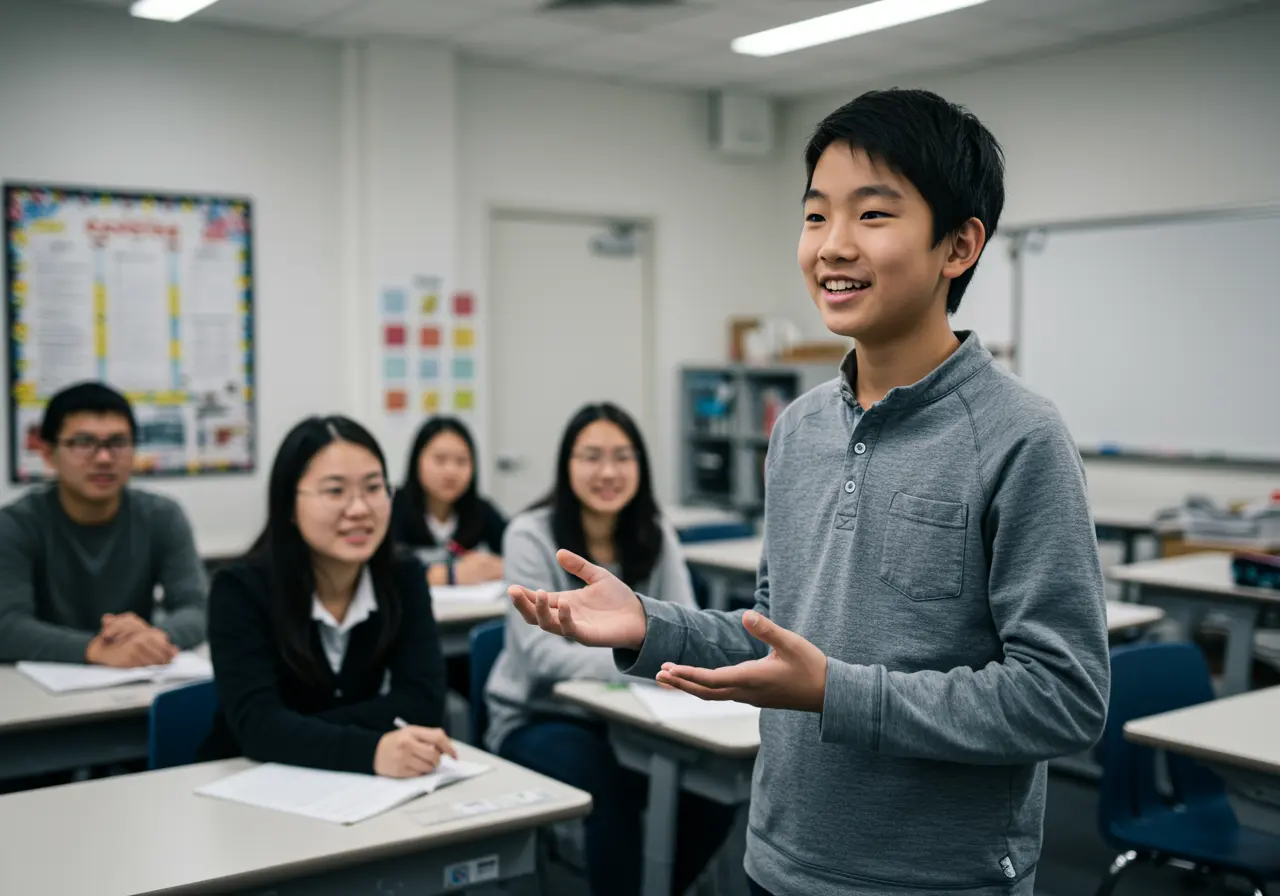
Founded by Iwan Yang, SuperMinds teaches real-world communication, not performance, not elocution, not speech and drama. It is built on a method proven first with adult professionals, then shaped for children and teens.
Book a trial class from S$59.50.
8. Frequently Asked Questions
What age is best to start teaching kids through storytelling?
Children as young as 4 or 5 can begin simple story retelling. For structured storytelling that builds communication skills, especially for PSLE Oral or DSA preparation, ages 9 to 12 (P3 to P6) is the ideal window. Teens benefit enormously too. The skills compound over time.
How does storytelling help with the PSLE Oral exam?
The Stimulus-Based Conversation component of the PSLE Oral requires students to speak fluently about a visual prompt, develop a clear point of view, and sustain a coherent response. Children who practise storytelling regularly handle this component far more confidently than those who haven’t.
My child is very shy. Can storytelling still work for them?
Yes, and storytelling is often especially helpful for shy children. Because the focus is on the story rather than on the child themselves, it reduces self-consciousness. Starting with low-stakes story-sharing at home builds the habit before any public speaking is required.
Is SuperMinds a speech and drama class?
No. SuperMinds teaches real-world communication, not performance. The focus is on everyday speaking, presenting ideas, handling questions, building conversations, not on acting, drama or elocution. Storytelling is used as a communication tool, not a theatrical one.
How is the SuperMinds trial class structured?
The trial class runs as a regular group session with a maximum of 8 students. Your child is video recorded speaking, and a coach provides a written evaluation of their communication strengths and areas to develop. It costs S$59.50.
What’s the difference between storytelling skills and narrative skills?
They’re closely related. Narrative skills refer to a child’s ability to structure and retell events coherently. Storytelling goes a step further, adding voice, perspective and purpose. Both are taught at SuperMinds because both are needed for confident, effective communication.
9. Start with a story.
If you want your child to communicate better, start tonight. Ask them to tell you something and just listen to how they tell it. That’s your baseline. From there, every story they tell is practice.
When you’re ready for structured coaching, book a trial class at SuperMinds from S$59.50.