

Your preschooler talks non-stop at home but freezes when a stranger says hello. That is completely normal at ages 4 to 6, and it is also the ideal age to start gently building the confidence to speak up.
You do not need a class for this yet. Public speaking for preschoolers begins at home, through everyday play and conversation. This guide shows you what helps, what to avoid, and when a structured programme becomes the right next step.
1. What "Public Speaking" Means for a Preschooler
For a four to six year old, public speaking has nothing to do with a stage or a microphone. It simply means being able to share a thought out loud and be understood: answering a question, telling a small story, or saying what they want without dissolving into shyness.
At this age the building blocks are vocabulary, the confidence to be heard, and the back-and-forth rhythm of conversation. These grow naturally through everyday talk, long before any formal practice. The goal is not a polished little performer. It is a child who feels safe speaking up.
2. Why the Preschool Years Matter
The early years are when language develops fastest. The everyday conversations a child has now lay the groundwork for how clearly and confidently they will speak later. Singapore's Nurturing Early Learners framework places language and communication at the heart of preschool development for exactly this reason.
Research backs this up. Studies on early childhood communication show that children who get frequent, responsive conversation build stronger language and social skills, as summarised in this review of early communication development. The habit of speaking and being heard compounds over the years that follow.
None of this requires drilling. For preschoolers, the most powerful tool is the ordinary conversation you are already having.
3. Five Simple Things to Do at Home
These cost nothing and fit into a normal day.

- Ask open questions. Swap "Did you have fun?" for "What was the best part of your day?" The dinner table is the easiest place to practise, and a few rounds of real back-and-forth each evening do more than any worksheet.
- Do a daily show-and-tell. Ask your child to pick one toy or drawing and tell you three things about it. It is public speaking in miniature.
- Tell stories together. Take turns adding a sentence to a made-up story. This builds sequencing and the confidence to speak without a script.
- Read aloud, then talk about it. After a picture book, ask what they think happens next and why.
- Let them order and ask. At the shop or restaurant, let your child order their own snack or ask the staff a question. Small real-world moments build real confidence.
4. Keep It Play, Not Performance
The fastest way to make a young child clam up is to make speaking feel like a test. At this age, the mode that works is play.
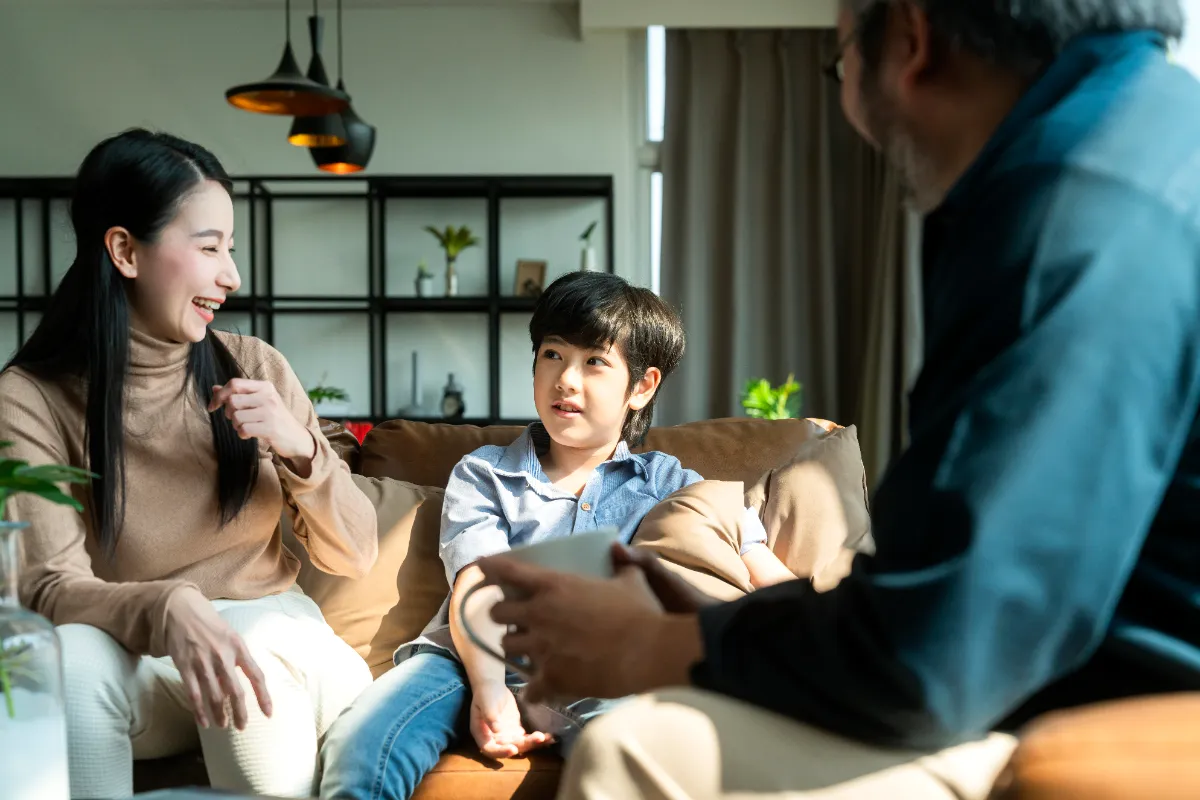
Keep it relaxed and low-stakes, like the easy chats you have on the sofa. Follow your child's interest rather than steering for a "correct" answer, and celebrate the trying rather than the polish. A child who feels listened to at home, without pressure, learns that speaking up is safe and even fun. That feeling is the foundation everything else is built on.
5. What to Avoid
A few well-meaning habits can backfire.
Do not correct every word. Constant correction makes a child hesitant. Model the right word naturally instead, and let small mistakes go.
Do not force performance. Making a shy child "say hello to auntie" on demand often deepens the reluctance. Invite, do not insist.
Do not compare. Children find their voice at their own pace. A quiet four-year-old is not behind.
6. When Structured Classes Make Sense
At the preschool stage, home is enough. Formal public speaking training is most useful later, from around age 9, when a child can reflect on their own speaking, take feedback, and practise deliberately in a group.
By upper primary, the same child who did show-and-tell at four is ready for more: PSLE Oral, class presentations, and DSA interviews. That is where a structured programme adds the most, building on the foundation you laid years earlier. For the early years, our guide to the best enrichment classes for preschoolers covers what to look for, and public speaking versus speech and drama explains the difference between the two approaches.
7. About SuperMinds
SuperMinds is Singapore's communication specialist for children and teens aged 9 to 17. Best known for public speaking, we help young people find their voice: the confidence to speak up, lead, and succeed in school and in life.
We are not a preschool centre, and our classes begin at age 9. The everyday habits you build with your four to six year old now are exactly the foundation we develop later, when your child is ready for structured practice. The method was pioneered by Iwan Yang, Founder & Programme Director and Singapore's most reviewed communication trainer, with 3,000+ students coached and 500+ five-star reviews. Classes run in groups of no more than 8, with a video recording and a written coach evaluation after a trial.
When your child reaches age 9, explore our classes for children (ages 9 to 12) at 250 Tanjong Pagar Road, St Andrew's Centre, #04-01, Singapore 088541, near Tanjong Pagar MRT. A trial class is S$59.50. WhatsApp us at +65 6602 8262.
8. Frequently Asked Questions
At what age can a child start public speaking?
Building speaking confidence begins from birth through everyday conversation. Structured public speaking classes are most effective from around age 9, when children can practise deliberately and take feedback.
My preschooler is very shy. Is that a problem?
Not at all. Shyness is normal and common at 4 to 6. With gentle, low-pressure encouragement at home, most children grow more comfortable speaking up in their own time.
Should I enrol my preschooler in a public speaking class?
Usually not necessary. At this age, daily conversation, show-and-tell, and storytelling at home do more than a formal class. Structured programmes suit children from around age 9.
How is public speaking different from speech and drama for young children?
Speech and drama for young children focuses on creative performance and imagination. Public speaking focuses on clear, confident everyday communication. For preschoolers both are playful, and the home habits in this guide support either path.
How much time does this take at home?
Very little. A few minutes of real conversation at meals, one short show-and-tell, and a shared story at bedtime are enough. Consistency matters more than length.
When should we consider a structured programme?
Consider one from around age 9, especially as PSLE Oral and school presentations approach, when your child can benefit from deliberate practice and coaching.
When your child is older and ready, a SuperMinds trial class is a great next step. Book a trial for S$59.50.