


Your child has something to say. The question is whether they know how to say it.
Storytelling is not just a creative skill. It is the foundation of how your child will express themselves in class presentations, in DSA interviews, in job interviews years from now, and in every conversation that matters in between.
This guide covers what storytelling and narrative skills actually are, why they matter for children in Singapore, and what you can do to help your child develop them.
1. What storytelling and narrative skills actually mean
2. Why storytelling skills matter early
3. The skills inside storytelling
4. How storytelling connects to the PSLE Oral and DSA interviews
5. How to develop storytelling skills at home
6. What good storytelling looks like at different ages
1. What storytelling and narrative skills actually mean
Storytelling is not about fiction or performance. It is about structure.
A child with strong narrative skills can take what is inside their head (an experience, an opinion, an idea) and organise it into something another person can follow and feel. They know where to begin. They know what to leave out. They know how to land.
That skill is not just useful in English class. It is the same skill that helps your child answer a question in a DSA interview without rambling. The same skill that helps them explain their thinking in a class debate. The same skill that helps them connect with people throughout their lives.
Most children are never taught this explicitly. They are told to write stories or do show and tell, but they are rarely taught how a story works and why it lands the way it does.
2. Why storytelling skills matter early
Children who can tell a clear story find it easier to write. They find it easier to present. They find it easier to make friends, because they can share themselves in a way that draws people in rather than confuses them.
The relationship between storytelling and reading comprehension is well established. Children who understand how stories are structured (that there is a beginning that sets something up, a middle that creates tension, and an end that resolves it) read with more depth and retention.
Beyond academics, narrative ability shapes how your child is perceived. A child who can tell a clear, engaging story of something that happened to them is the child who gets listened to. Who gets taken seriously. Who people want to hear from again.
These habits form early. A child who practises organising and expressing their experiences from age 9 will find it far more natural at age 15 than one who starts then.
3. The skills inside storytelling
When we talk about storytelling and narrative skills, we are really talking about a cluster of abilities working together.
Structure. Knowing how to sequence events so they build on each other rather than just listing what happened. Beginning with something that makes the listener lean in. Building to a moment that matters. Ending with something that lands.
Detail and specificity. Knowing which details to keep and which to cut. A child who says “we went to the park and it was fun” has left their listener with nothing. A child who says “my brother and I built a shelter out of fallen branches and it actually held up” gives you something to see.
Emotion and perspective. Stories connect when they are honest. A child who can name what they felt, not just what happened, invites their listener into the experience rather than reporting it from a distance.
Pacing. Knowing when to slow down and when to move forward. The best storytellers pause on the moments that matter and skip over the parts that do not.
Audience awareness. Adjusting the story for who is listening. What a child shares with a friend over lunch is different from what they share with a teacher in class. Knowing that difference is a social skill as much as a communication skill.
4. How storytelling connects to the PSLE Oral and DSA interviews
The PSLE Oral Stimulus-Based Conversation is, at its core, a storytelling task. Your child is shown an image and asked to respond to it personally. The children who do well are the ones who can connect the image to a specific experience of their own and share it clearly, with a point.
That is narrative skill. Not a script. Not a model answer. The ability to take something real from their life and shape it into a response that goes somewhere.
In a DSA interview, panels are looking for a child who can speak about their interests and experiences honestly. Generic answers (“I joined robotics because I like technology”) do not move panels. Specific, shaped stories do. “I joined robotics because I wanted to understand why the bridge I had designed in a school project kept collapsing. It turned out I had not accounted for the load distribution.” That answer shows thinking, curiosity, and narrative control.
The children who secure Confirmed Offers are often not the most accomplished. They are the ones who can tell their story in a way that is clear, specific, and genuine. Read how one SuperMinds family navigated the DSA process and what made the difference on interview day.
5. How to develop storytelling skills at home
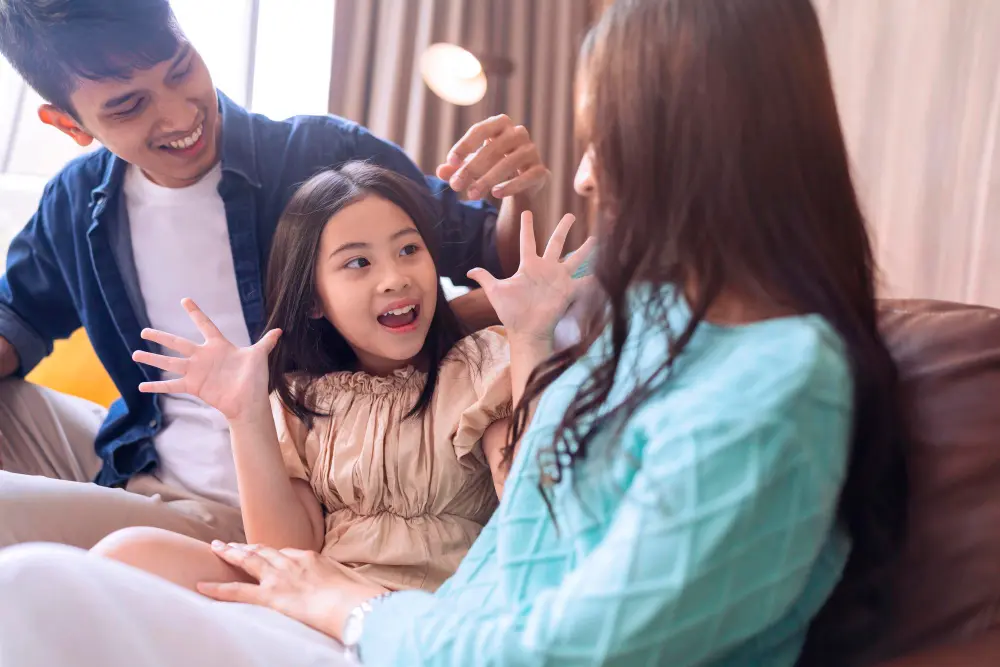
You do not need a curriculum. You need consistent, low-pressure practice in everyday moments.
Ask better questions at the dinner table. “How was school?” produces nothing. “Tell me one thing that surprised you today” requires your child to select a moment, give it shape, and share it. That is a storytelling exercise.
Slow down the retelling. When your child tells you about something that happened, resist the urge to move on quickly. Ask: “What happened just before that?” “How did you feel at that point?” “What did you do next?” You are teaching them that a story has layers.
Read aloud together and notice structure. After reading a chapter or a short story, ask your child what the turning point was. What changed? When did they feel the tension? This builds the internal map of what makes a story work.
Give them low-stakes speaking practice. Ask your child to tell you about a film, a book, or a game they enjoyed. Then ask: “What was the moment you liked most? Why?” You are practising the same skill a DSA panel is looking for: the ability to identify what matters and say why.
Let them practise with an audience. Storytelling is a social skill. It develops when there is someone listening. Grandparents, cousins, family friends: these are low-stakes audiences where your child can practise speaking and reading a room.
6. What good storytelling looks like at different ages
At Primary 3 to 4, children are learning to sequence events in order and include some sense of why something mattered. Their stories often jump around or miss the point. That is normal. The priority is helping them understand that a story has a point, not just a sequence.
At Primary 5 to 6, children can begin to think about their audience. They can start to consider: what does the listener already know? What do I need to explain? What can I skip? This is also the age when specificity starts to make a real difference: helping your child replace “it was fun” with something they can actually see.
At Secondary 1 and beyond, the expectation shifts to perspective and reflection. A teenager who can tell a story and then say what they learned from it, or how it changed the way they think, is demonstrating exactly the maturity that secondary school teachers and DSA panels are looking for.
7. When to consider structured storytelling coaching
Home practice takes you a long way. But if your child struggles to organise their thoughts when speaking, gives one-word answers under pressure, loses track of what they are saying mid-sentence, or becomes visibly anxious when asked to speak in front of others, structured coaching will move them forward faster than practice alone.
At SuperMinds, storytelling is not a separate subject. It runs through every public speaking class for children. Children practise taking their real experiences and shaping them into clear, engaging accounts. They receive video feedback so they can see themselves and hear the difference over time.
8. About SuperMinds
SuperMinds is a public speaking and communication enrichment programme for children and teens aged 9 to 17 in Singapore. Every class reflects the method developed by Iwan Yang, Singapore’s most reviewed communication trainer, with more than 500 five-star reviews and 3,000+ students coached across Singapore and Asia.
Classes run in groups of a maximum of 8. Every child speaks in every session. Every trial class includes a video recording of your child speaking and a written evaluation from a SuperMinds coach.
Book a trial class: S$59.50. WhatsApp +65 6602 8262 or visit superminds.com.sg.
250 Tanjong Pagar Road, St Andrew’s Centre, #04-01, Singapore 088541. Near Tanjong Pagar MRT.
9. Frequently asked questions
At what age should my child start developing storytelling skills?
The earlier the better, but 9 to 12 is a particularly valuable window. Children at this age have enough life experience to draw on and enough language to express it. They are also still forming their communication habits, which makes them receptive to structured practice.
My child is not a creative person. Will storytelling still help them?
Storytelling is not about imagination or fiction. It is about organising real experiences and expressing them clearly. A child who can describe exactly what happened during a science experiment and explain what surprised them about the result is telling a strong story. Creativity helps, but it is not the point.
How does storytelling practice help with the DSA interview?
DSA panels want to hear specific, honest accounts of what your child has done and why it matters to them. A child who has practised taking their experiences and giving them shape and point will answer interview questions with far more impact than one who has memorised a script. The panel can immediately tell the difference.
How is this different from speech and drama?
Speech and drama develops creativity and performance skills through acting and character work. Storytelling at SuperMinds focuses on real-world communication: helping your child take their own experiences and express them clearly to a real audience. Both have value, but they build different things.
Will this help my child with the PSLE Oral?
Yes. The Stimulus-Based Conversation component specifically rewards children who can connect a visual prompt to a personal experience and share it with a clear point. That is a storytelling skill, and it is practised directly in SuperMinds classes.
My child tells long, rambling stories that go nowhere. Is that fixable?
Yes, and it is one of the most common things we work on. Children who ramble are usually not lacking in ideas: they are lacking in structure. Once they learn to identify the point of what they want to say before they start saying it, the rambling reduces quickly. It takes practice, but it is very teachable.
SuperMinds is located at 250 Tanjong Pagar Road, St Andrew’s Centre, #04-01, Singapore 088541, near Tanjong Pagar MRT. WhatsApp: +65 6602 8262. superminds.com.sg