

Every June, Singapore parents start comparing enrichment options. Which are the best enrichment classes for kids, and which are just filling time?
The problem isn't a shortage of choices. Singapore has enrichment for almost everything: math, coding, chess, tennis, public speaking, art, robotics. The problem is knowing what you're really choosing between.
Most parents make enrichment decisions based on what's convenient, what their child's friends are doing, or what's currently popular. Few have a clear framework for evaluating whether a class will actually make a meaningful difference.
This guide gives you that framework, and explains why one category of enrichment consistently delivers more long-term value than parents expect.
1. What Makes a Good Enrichment Class? 5 Questions Every Parent Should Ask
Before comparing providers or programmes, every enrichment decision should pass the same five questions. These apply whether you're evaluating a coding camp, a tennis academy, or a communication skills programme.
Question 1: What specific skill does this class develop, and how will you see it in your child's daily life?
Vague outcomes like "builds confidence" or "improves thinking skills" are marketing, not measures. A good enrichment class should produce observable changes. Ask the provider: what will my child be able to do after 10 sessions that they can't do now?
If the answer is specific ("your child will be able to give a two-minute structured talk to an unfamiliar audience without notes"), that's a good sign. If it stays vague, keep asking.
Question 2: How does the class measure progress?
Enjoyment is not a measure of learning. Many children enjoy activities they're not growing in. Ask how the programme tracks individual progress; written evaluations, video recordings, or parent reports are all signals that feedback is built into the system, not just a nice-to-have.
Question 3: What is the class size and how much individual attention does your child receive?
In a class of 20 students, your child may receive less than three minutes of direct feedback per session. Smaller class sizes, ideally under 10 students, mean more practice time, more personalised instruction, and faster progress.
Question 4: Does the methodology come from proven practice?
Some programmes are designed specifically for children with no external evidence base. The strongest programmes adapt methods that have already been proven effective with adults or in real-world settings, then translate them for children. Ask where the approach comes from and how it was developed.
Question 5: Does this class complement what your child is already doing?
Enrichment shouldn't add stress. Consider whether the skills developed compound across subjects; communication skills, for example, help in every class your child attends. Or whether you're adding more of the same cognitive load they already carry in school.
2. The Main Enrichment Categories in Singapore (and What Each Develops)
Understanding what each enrichment category actually builds helps you match the right programme to your child's specific gaps, rather than defaulting to what's most popular.
Communication and confidence skills
This covers speaking clearly under pressure, active listening, structuring arguments, handling feedback, and building presence in front of others. Unlike most enrichment, communication skills transfer directly to every other subject and every stage of your child's future: PSLE Oral, DSA interviews, group projects, university presentations, and eventually job interviews. This is the category most Singapore parents underestimate.
Academic enrichment and tuition
Math, English, Science and other subject-specific programmes. This is the most common category and the most familiar to Singapore parents. It builds exam performance in specific subjects. Its limitation is that it doesn't transfer. Stronger math doesn't help a child who struggles to articulate their thinking or engage confidently in class discussions.
STEM and coding
Logical thinking, computational reasoning, and problem-solving. A strong category for children interested in technology or engineering, and one that complements academic enrichment well. Skills developed here, breaking a problem into steps, testing and iterating, are genuinely useful beyond school.
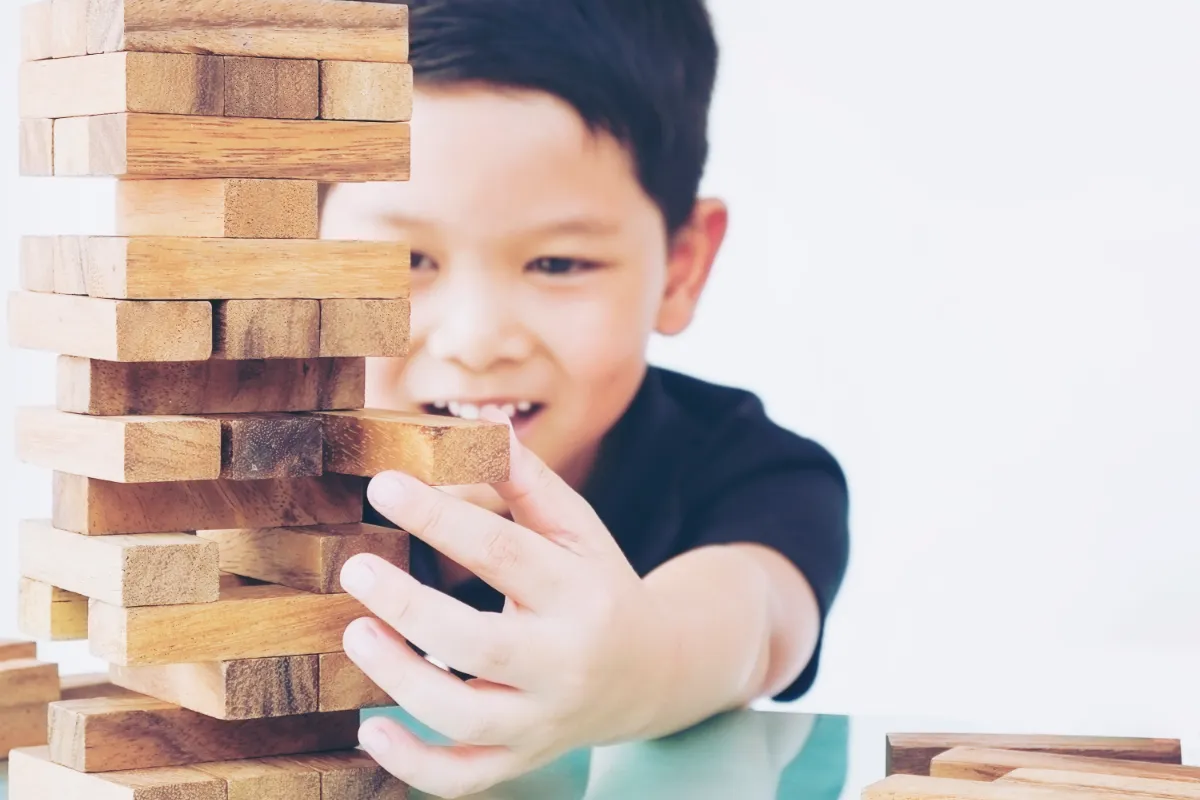
Picture a child stacking a wobbling tower of wooden blocks, testing each piece, watching it lean, and trying a different placement when it topples. That is computational thinking in miniature: break the problem into steps, test, and try again.
Arts
Music, visual arts, dance, and drama. These develop creative expression, fine motor skills, and emotional regulation. Drama in particular can help shy children build self-expression, though it's worth noting that performance on stage differs from speaking confidently in an everyday conversation or classroom discussion.
Sports and physical activities
Teamwork, discipline, resilience, and physical health. Important for balance, especially if your child's week is otherwise mostly sedentary. The habits built through regular physical training, showing up, handling a loss, committing to improvement, have value beyond the sport itself.
3. Why Communication Skills Should Come First
If you have space for only one enrichment class, or if you're deciding which existing class to prioritise, the evidence points consistently to communication skills.
Singapore's Ministry of Education identifies communication, collaboration, and civic literacy as the three core competencies underlying all 21st-century skills. These aren't peripheral to academic success. They're foundational to it. A child who listens well, asks good questions, and expresses their understanding clearly learns more effectively in every subject they attend.
The World Economic Forum's Future of Jobs Report 2025 lists communication, creative thinking, and resilience among the top skills children will need, ahead of technical skills increasingly handled by AI.
There's also a compounding effect that rarely gets mentioned: communication skills make every other enrichment more valuable. A child who learns to ask better questions gets more from their math tuition. A child who can articulate their thinking participates more actively in class. A child who handles feedback well improves faster in tennis, piano, and coding, because they can actually use the corrections they receive.
Communication skills compound across every other subject and skill a child develops. Developing them early doesn't replace other enrichment. It multiplies the return from everything else. The two halves of that skill, active listening and persuasive speaking, are exactly what a strong communication programme sets out to build.
4. How Many Enrichment Classes Is Enough?
There's no single right answer, but most child development research suggests that primary school children benefit most from two to three structured activities outside school. Beyond that, the schedule begins to crowd out the unstructured time children need for rest, play, and genuine consolidation of what they're learning.
The afternoon your child spends curled up on the sofa with a book is not wasted time. It is where everything they are learning quietly consolidates, which is exactly what an over-packed schedule crowds out.

The more useful question isn't "how many classes can we fit in?" It's "which one or two skills, if developed now, would make the biggest difference in the next three years?"
A few practical filters. If your child already attends two or more enrichment classes, adding a third should mean subtracting something else. Spreading attention across too many activities produces surface-level exposure, not real development.
If your child is in P5 or P6, focus first on what directly supports PSLE. Then use the school holidays to add something genuinely developmental, such as a holiday communication camp, rather than more academic work.
If your child is moving into lower secondary, communication skills become more important, not less. DSA interviews, CCA leadership, group projects, and secondary school oral presentations all draw on the same foundational ability to speak clearly and think on their feet.
One well-chosen enrichment class with genuine feedback and a clear methodology will consistently outperform three classes that simply fill the schedule.
5. What to Look for in Communication and Confidence Enrichment
When evaluating communication programmes for children aged 9 to 17, the same five questions apply, but a few additional criteria matter for this specific category.
Look for real-world communication skills, not performance training. Speech and drama classes develop stage performance. What most children need is the ability to speak clearly in everyday situations: answering a teacher's question, presenting in class, making their point in a group discussion, or handling disagreement calmly. These require different skills and different training.
Look for a methodology proven with adults first. The strongest children's communication programmes adapt frameworks validated with professionals, where the stakes for poor communication are tangible and the feedback loop is tighter. That means the method has already been stress-tested before it reached the classroom.
Look for small classes with individual feedback on every session. In communication training, the ratio of active practice to passive listening determines how fast a child improves. Classes of eight or fewer students give each child more time to speak, more cycles of feedback, and real measurable progress.
About SuperMinds
SuperMinds is Singapore's communication specialist for children and teens aged 9 to 17, founded by Iwan Yang, Founder & Programme Director. Best known for public speaking, we help young people find their voice: the confidence to speak up, lead, and succeed in school and in life. The SuperMinds method was originally developed for adult professionals, and brought to children after parents who had completed the adult programme asked Iwan to work with their sons and daughters. That origin matters: the approach was proven in high-stakes adult environments before it was adapted for children.
One primary school student, who could barely raise her hand to answer a question in Term 1, delivered a confident, structured talk to her class without notes by the end of the programme. That shift from avoidance to confidence is what the programme is built to produce.
Classes are delivered by Iwan Yang and trained SuperMinds coaches working under his method and supervision, and are capped at 8 students. Every child receives a video recording of themselves speaking and a written coach evaluation after their trial class, so parents can see exactly where their child stands before committing further.
Explore the SuperMinds children's programme for ages 9 to 12 (P3 to P6), or the teens programme for Sec 1 to 4 students. If your child is in P5 or P6 preparing for DSA, one-on-one DSA interview coaching with Iwan Yang is also available.
Trial class: S$59.50. Every trial includes a video recording of your child speaking and a written coach evaluation.
6. Frequently Asked Questions
What age should kids start enrichment classes in Singapore?
Most children benefit from structured enrichment from Primary 3 onwards (around age 9), when they have enough focus to engage with individual feedback. For communication and confidence skills specifically, starting before P5 and P6 gives children time to build the skills they'll need for PSLE Oral exams, DSA interviews, and the increased oral demands of secondary school.
What's the difference between enrichment and tuition?
Tuition reinforces academic content from the school syllabus. It covers the same subjects your child is already studying. Enrichment develops skills and competencies that school doesn't fully cover, such as public speaking, coding, music, or sport. Enrichment typically produces skills that transfer across subjects and life stages; tuition produces subject-specific exam performance.
How much do enrichment classes cost in Singapore?
Costs vary significantly by category and class format. Academic group tuition typically ranges from S$200 to S$500 per month. Specialised enrichment programmes such as communication training, music lessons, or coding typically range from S$400 to S$800 per term depending on class size and structure. Most reputable providers offer a trial session so you can evaluate the fit before committing.
Is enrichment worth it for primary school children?
It depends on what the class actually develops. Enrichment that builds a genuinely transferable skill, such as real-world communication, a lifelong sport, or musical fluency, tends to deliver lasting value well beyond the school years. Enrichment that mainly adds academic workload your child is already receiving in school delivers diminishing returns.
What enrichment is best for DSA preparation?
DSA preparation depends on which talent area your child is applying through. For interview-based DSA pathways, communication training is one of the most effective forms of preparation. Interviewers assess how candidates think and express themselves under pressure, not just what they know. SuperMinds offers one-on-one DSA interview coaching for Primary and Secondary school students, conducted directly by Iwan Yang.
Ready to see what SuperMinds can do for your child?
The trial class is S$59.50 and includes a video recording of your child speaking and a written coach evaluation, so you can see exactly where they stand.
Book your trial class today →