
The PSLE Oral examination is one of the most misunderstood components of the Primary School Leaving Examination.
Many children prepare by memorising model answers or reading as many practice passages as possible. These habits help to a point. But the children who do well in PSLE Oral are usually the ones who can speak naturally, respond to the examiner's prompts, and share a genuine opinion with some structure behind it.
This guide covers the current PSLE Oral format, what examiners are actually looking for, and practical PSLE oral exam tips 2026 you can use to help your child prepare.
1. How the PSLE Oral examination works in 2026
2. What PSLE oral examiners are looking for
3. PSLE oral exam tips for the Reading Aloud component
4. PSLE oral exam tips for the Stimulus-Based Conversation
5. What not to do when helping your child prepare
6. When to consider PSLE Oral coaching
1. How the PSLE Oral examination works in 2026
The PSLE Oral examination has two components.
Reading Aloud (15 marks). Your child reads a passage of approximately 200 words aloud to the examiner. This is assessed on pronunciation, articulation, expression, and fluency. Monotone reading, stumbling on words, or rushing through the passage all affect the score.
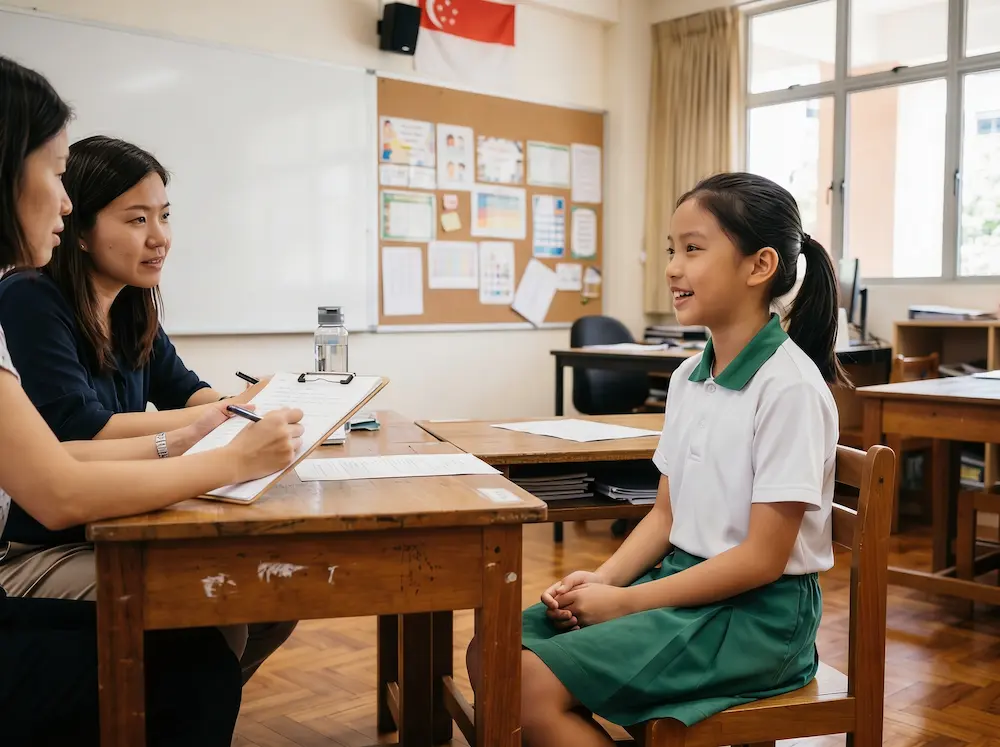
Stimulus-Based Conversation (25 marks). Your child is shown a visual stimulus (typically a photograph related to a theme). They describe what they see, share a personal response, and then have a conversation with the examiner on a related topic. This is the more heavily weighted component, and the one that catches many children off guard.
Total oral examination time is approximately 10 minutes. The marks make up a meaningful portion of the overall English score. You can find the full PSLE English oral assessment framework on the MOE website.
2. What PSLE oral examiners are looking for
Examiners are not looking for perfect answers. They are looking for a child who can communicate.
Specifically, they are assessing:
Fluency and confidence. Does the child speak smoothly and at a natural pace? Do they hesitate excessively or trail off mid-sentence?
Organisation. Are the child's ideas presented in a logical sequence? Is there a clear point, followed by a reason or example?
Relevance. Does the child actually answer the question asked? Examiners specifically note when a child gives a rehearsed response that does not address the prompt.
Personal engagement. The best Stimulus-Based Conversation responses are specific and personal. "I think exercise is important because my sister and I go cycling every Saturday at East Coast Park and I always feel more focused afterwards" scores better than "Exercise is important because it is healthy."
3. PSLE oral exam tips for the Reading Aloud component
Practise reading aloud every day. Even five to ten minutes of daily reading aloud, from any source, builds fluency and reduces hesitation. Variety in material (news articles, children's books, fiction and non-fiction) helps your child handle unfamiliar vocabulary calmly.
Focus on punctuation. Most children rush through commas and ignore full stops. Practise pausing at commas (brief) and full stops (longer). This alone improves pacing and expression significantly.
Aim for crisp articulation. Examiners are marking clarity. Get your child to finish each word cleanly, especially final consonants like 't', 'k', 'd', and 's', instead of letting them trail off. Reading slightly slower than feels natural, with every word landing crisply, is an easy habit to build into daily practice.
Do not over-dramatise. Reading Aloud is not a performance. Natural expression is the goal. Recording your child and playing it back helps them hear the difference between flat monotone and natural, expressive reading.
Work on specific vocabulary your child struggles with. Make a list of words your child mispronounces and practise those specifically. Common ones in Singapore include words ending in '-ture', '-tion', and '-ough'.

4. PSLE oral exam tips for the Stimulus-Based Conversation
Teach your child the PEEL framework. Point, Evidence, Explanation, Link. When the examiner asks a question, your child should make a clear point, support it with a specific example from their own experience, explain why it matters, and link back to the question. This structure is natural enough to use in conversation and specific enough to impress.
Practise describing images. Sit with your child and show them photographs from newspapers, magazines, or online. Ask them to describe what they see and then share an opinion about it. Start with five minutes and increase as they become more comfortable.
Have real conversations about real topics. The Stimulus-Based Conversation often touches on themes like technology, the environment, community, and healthy living. Ask your child what they think about these topics at the dinner table. The goal is not to teach them a model answer. It is to help them form and express a genuine opinion.
Teach them to handle unfamiliar questions. The examiner will often ask something unexpected. Teach your child to pause briefly, acknowledge the question, and think before they speak. "That is a good question. I think..." is a composed response that gives your child a moment to gather their thoughts.
5. What not to do when helping your child prepare
Do not over-script. Examiners can immediately tell when a child is reciting a memorised answer. It affects fluency and the mark. Help your child understand the topic and their own opinion, not a pre-written response.
Do not let anxiety drive the preparation. The most common reason children underperform in PSLE Oral is tension, not lack of knowledge. A child who speaks naturally and with reasonable confidence will score better than a child who has memorised more but is visibly anxious. Keep practice sessions low-pressure.
Do not leave it to the last week. Fluency and confidence are built over time. Six to eight weeks of consistent practice will do far more than a week of intensive cramming before the examination.
6. When to consider PSLE Oral coaching
If your child consistently struggles to express their thoughts in full sentences, loses track of what they are saying mid-answer, speaks in a very flat or monotone voice, becomes noticeably anxious when asked to speak in front of others, or has never had structured speaking practice, a communication coaching programme will give them more than exam tips alone can provide.
SuperMinds runs PSLE Oral preparation workshops specifically designed for Primary 5 and Primary 6 students. We use various frameworks, and mock examiner conversations to prepare children in a structured, low-pressure environment. The same storytelling skills we build in our weekly classes apply directly to the Stimulus-Based Conversation.

7. About SuperMinds
SuperMinds was founded by Iwan Yang, Singapore's most reviewed communication trainer, with more than 500 five-star reviews and 3,000+ students coached across Singapore and Asia.
Our PSLE Oral preparation programme is conducted in small groups of 8, at 250 Tanjong Pagar Road, St Andrew's Centre, #04-01, Singapore 088541. Near Tanjong Pagar MRT. WhatsApp: +65 6602 8262. superminds.com.sg
8. Frequently asked questions about PSLE Oral 2026
When does the PSLE Oral examination take place?
PSLE Oral typically takes place in August, before the written papers in October. Schools confirm exact dates, and preparation is ideally underway from Term 2 of Primary 6.
How much does the PSLE Oral affect the overall score?
The English Oral component carries 15% of the overall English grade (40 marks out of 280). This is meaningful: a child who does significantly better or worse in oral than in written components will see an impact on their final band score.
Can preparation for PSLE Oral help with other subjects?
Yes. The habits developed in oral preparation (structured thinking, clear expression, listening to the question before answering) carry over to all oral and conversational assessments, including Mother Tongue oral and secondary school presentations.
Should my child memorise model answers?
No. Model answers can be useful for understanding what a good response looks like, but memorising them for use in the exam almost always backfires. Examiners ask follow-up questions that a memorised answer cannot address. Teach your child to have an opinion and express it, not to recite.
My child speaks English at home but still struggles to express ideas clearly. Why?
Speaking casually at home and speaking in an organised, assessed conversation are different skills. Many children who are perfectly fluent socially struggle in structured speaking contexts because they have never practised thinking and speaking at the same time with someone assessing them. Structured coaching addresses this directly.
9. The next step
PSLE Oral is a skill examination. Preparation should start well before August.
Book a trial class at SuperMinds and see exactly where your child stands. You will receive a video recording of your child speaking and a written evaluation from a SuperMinds coach.
Trial class: S$59.50. WhatsApp +65 6602 8262 or book at superminds.com.sg.
250 Tanjong Pagar Road, St Andrew's Centre, #04-01, Singapore 088541. Near Tanjong Pagar MRT.