


Every parent wants a confident child. But confidence that is not built on character is just bravado: loud one moment, lost the next. The two have to grow together.
This guide explains the difference between character and confidence, why both matter so much for children in Singapore, and the practical things you can do at home to build them. Real, steady confidence can be nurtured, and it lasts.
1. Confidence and Character: What's the Difference?
Confidence and character are often spoken of together, but they are not the same thing. Confidence is the belief that you can handle what comes your way. Character is who you are when you do: honesty, kindness, responsibility, and the resolve to do the right thing.
One without the other does not hold up. Confidence without character can tip into arrogance or bravado: a child who is sure of themselves but careless with others, and who crumbles the moment things get hard. Character without confidence is just as limiting: a thoughtful, principled child who never speaks up, so their best qualities stay hidden.
Put them together and something strong emerges: a child who believes in themselves and uses that belief well. They speak up, but they also listen. They take the lead, but they share the credit. They try hard things, and when they fail, their character carries them back to try again.
This is why character and confidence building for kids works best as one project, not two. And the good news for parents: both are built, not born. A naturally quiet child can grow genuine confidence, and any child can be guided toward stronger character.
2. Why Character and Confidence Matter for Kids in Singapore
In Singapore, academic results have always carried weight. But schools and employers increasingly look for more than grades. As technology takes over routine work, the human qualities are what set a young person apart: confidence, character, and the ability to connect.
Singapore's education system already treats this as core, not optional. Through Character and Citizenship Education, every school nurtures values such as respect, responsibility, and resilience from Primary 1 onwards. These are exactly the traits that character and confidence building develops.
The stakes feel high to children, too. In a competitive environment, a child who lacks confidence may avoid speaking in class, shrink from new challenges, or define themselves by a single bad grade. A child with steady confidence and strong character handles setbacks, makes good choices under pressure, and keeps their sense of self intact.
These qualities also underpin every other skill a child will build, from leadership to handling feedback. Confidence is what lets a child use what they know; character is what makes it count.
3. How Character Creates Lasting Confidence
Here is the part many programmes miss: real confidence is a by-product of character, not a substitute for it. You cannot simply tell a child to feel confident. They earn it by doing hard things, behaving well, and seeing the results.
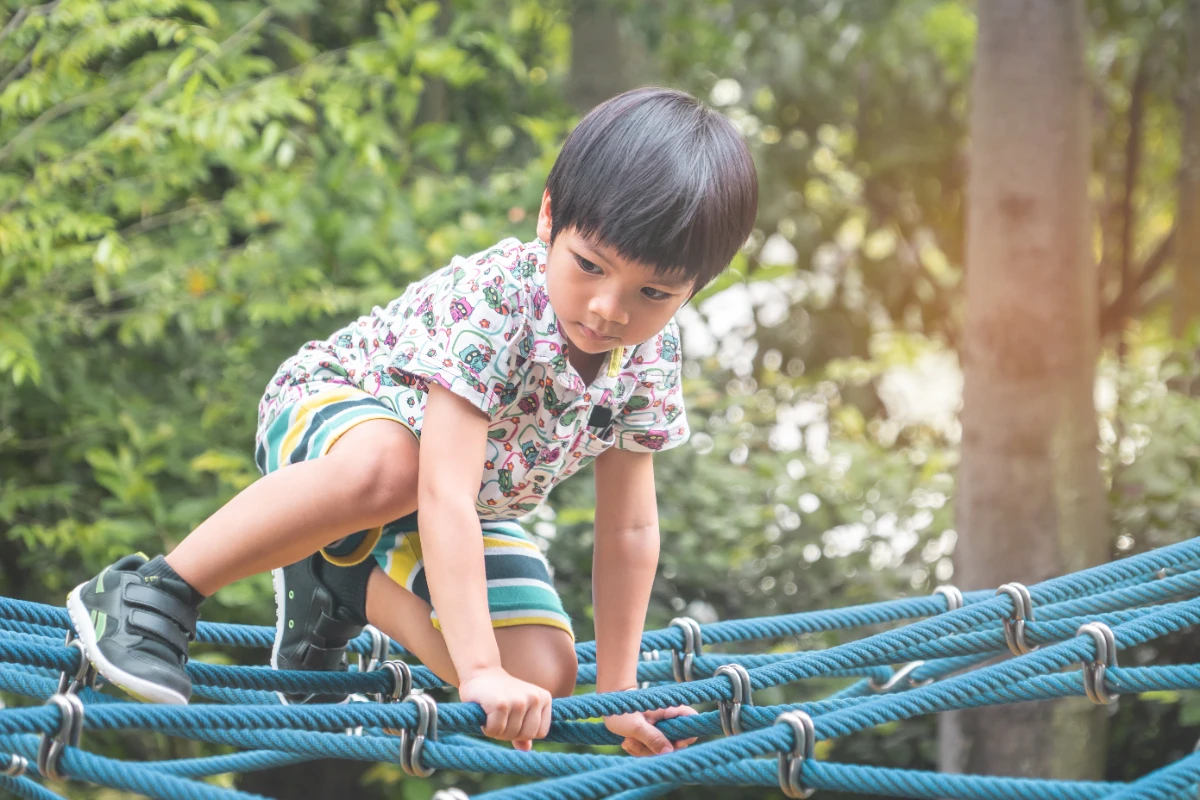
Think of a child crossing a high rope bridge at the playground for the first time. They are nervous. They go slowly, wobble, and keep going. When they reach the other side, no one had to tell them they were brave. They felt it. That feeling, earned through effort, is the only kind of confidence that lasts. The Child Mind Institute notes that children build genuine self-confidence by mastering challenges and bouncing back from failure, not by being praised for things that came easily.
Character is what makes that possible: the resilience to try again after wobbling, the honesty to admit it was hard, and the responsibility to finish what they started. Each time a child draws on a character trait to get through something difficult, their confidence grows on solid ground.
This is why "confidence-only" approaches tend to fade. A child who is praised constantly but never stretched learns to fear challenge, because their confidence has nothing real underneath it. Build the character, and the confidence takes care of itself.
4. How to Build Character and Confidence at Home
Parents are the first and most important builders of both. You do not need a curriculum, just a few consistent habits.

Praise effort and character, not just results. Instead of "you're so clever," try "I saw how hard you worked on that" or "that was kind of you." As the Mayo Clinic Health System notes, praising effort teaches children they can grow, which builds confidence that lasts. A simple thumbs-up for trying hard tells your child the right thing is being noticed.
Let them struggle a little. Resist fixing every problem. A child who is allowed to wrestle with something and get there builds both competence and the belief that they can.
Give them real responsibilities. A chore that genuinely matters to the family teaches accountability, and finishing it builds quiet pride.
Model it. Let your child see you stay honest, own a mistake, and stay calm when things go wrong. Character is caught more than taught.
If your child is especially quiet or holds back in groups, our guide on building confidence in a shy child goes deeper on gentle, practical steps.
5. Choosing a Character and Confidence Programme in Singapore
Many programmes promise confidence. Fewer build the character that makes it real. If you are considering a confidence building course in Singapore, these questions help you tell them apart.
Does it build skills, or just hype kids up? A weekend of high-energy games can leave a child buzzing but unchanged. Look for genuine skill-building such as speaking, listening, and problem-solving, practised over time.
Is character part of it? Ask how the programme develops traits like resilience, responsibility, and empathy, not just stage presence. Confidence without character does not last.
How small are the classes? Quieter children need space and individual attention to step up. Ask the maximum class size.
Can you see the growth? Look for feedback you can observe, such as a recording, a coach's notes, or a final presentation, so progress is real, not just a feeling.
A good programme grows the child from the inside out, so the confidence they leave with is theirs to keep.
6. About SuperMinds
SuperMinds is Singapore's communication specialist for children and teens aged 9 to 17. Best known for public speaking, we help young people find their voice: the confidence to speak up, lead, and succeed in school and in life. Our approach is built on three things that work together: Character, Communication, and Confidence.
That order is deliberate. It began when adults trained by our founder, Iwan Yang, asked him to teach their children the same skills, so the method was proven on adults first, then shaped for young learners. It builds confidence on a foundation of character, not the other way round. Iwan, Founder & Programme Director and Singapore's most reviewed communication trainer, has coached 3,000+ students and earned 500+ five-star reviews.
In groups of no more than 8, children practise speaking up, working with others, and handling challenges, with a video recording and a written coach evaluation after a trial, so growth is something you can see.
We run classes for children (ages 9 to 12) and classes for teens (ages 13 to 17) at 250 Tanjong Pagar Road, St Andrew's Centre, #04-01, Singapore 088541, near Tanjong Pagar MRT. A trial class is S$59.50 and includes a video recording of your child speaking and a written coach evaluation. You can reach us on WhatsApp at +65 6602 8262.
7. Frequently Asked Questions
At what age should I start building my child's confidence and character?
It starts at home from the early years, but structured programmes are most effective from around age 9, when children can reflect on their own behaviour and practise skills in a group. SuperMinds runs programmes for ages 9 to 12 and 13 to 17.
Can confidence really be taught, or is it just personality?
While temperament plays a part, confidence is built through experience: mastering challenges, recovering from setbacks, and being recognised for effort. Any child can grow it with the right support.
What is the difference between confidence and self-esteem?
Self-esteem is how a child feels about their worth; confidence is their belief in what they can do. The two are linked, and building real competence tends to lift both.
My child is shy. Does that mean they lack confidence?
Not at all. Shyness is about temperament; confidence is about self-belief. A quiet child can be deeply confident, and confidence can be nurtured without changing who they are.
How long does it take to build a child's confidence?
There is no fixed timeline. It depends on the child and how consistently the habits are practised at home and in class. Most parents notice small changes within a few months: more willingness to try, speak up, or bounce back.
What is the difference between a confidence class and a public speaking class?
A public speaking class focuses on delivering a message well. A character and confidence programme is broader. It builds the self-belief and inner qualities that show up everywhere, including but not limited to speaking. At SuperMinds the two are taught together.
Want to help your child build confidence that lasts? Book a trial class for S$59.50 and see the difference for yourself.